Prediction Markets: Provided an Oracle
In 2014, the document that gave birth to Ethereum noted that prediction markets would be easy to build, “provided an oracle.” Twelve years later, people bet on elections, wars, the weather and the next pope, and the price of those bets is read as data. What we believe already has a price. And that changes all of us, whether we bet or not.

Listen to this story
Paris, April 2026
0:00 / 14:14
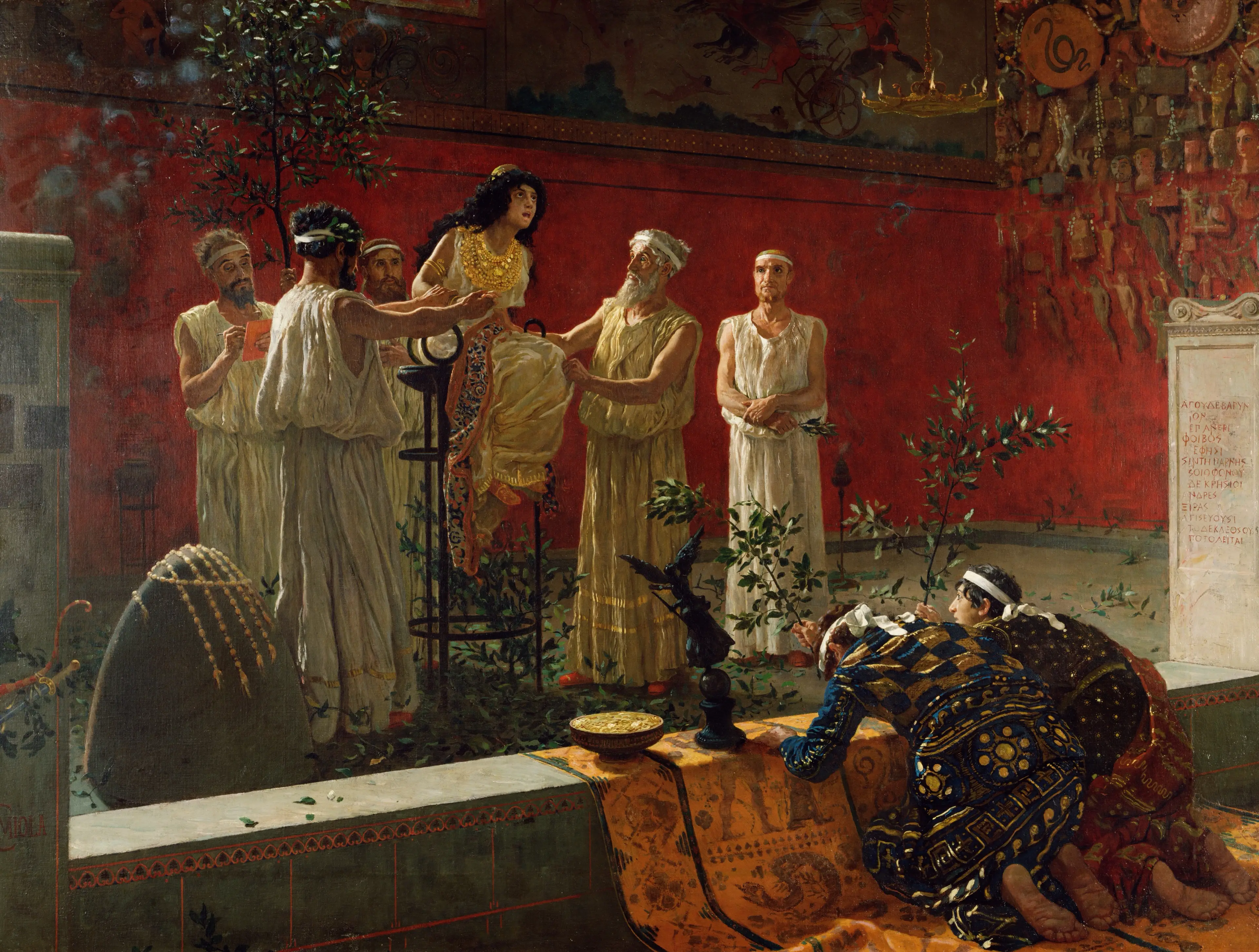
An oracle changes history not by being right, but by being believed. What’s new is a technology that puts a price on what we believe.
In 2014, a young programmer named Vitalik Buterin published the document that introduced Ethereum, a network like Bitcoin’s, but one where you can also write programs. Toward the end it lists things that could be built on top of it, and two of them, read today, sound like prophecy. One is a mechanism that lets a program find out what is happening outside: the price of a currency, say, or “the temperature in Berlin.” Programmers call it an oracle. The other is prediction markets, where people bet on what is going to happen. They would be, he wrote, “easy to implement.” The condition came at the start of the sentence: “provided an oracle.”1
Twelve years later, in April of this year, someone bet $119 that the maximum temperature in Paris on the 15th would reach about 18 degrees Celsius, and won more than $21,000. That day, the thermometer at Charles de Gaulle airport recorded a temperature spike that no other station in the area registered. Météo-France, France’s national weather service, filed a complaint over possible tampering with its sensor, and the Paris prosecutor’s office opened an investigation. On bettors’ forums, the theory was that someone had heated the thermometer with a lighter or a battery-powered hair dryer.2
The bet was placed on Polymarket, the largest of the prediction markets that run on cryptocurrency, and the oracle that decided who won was, ultimately, that thermometer. Afterward, the platform changed thermometers: it now settles bets on the Paris weather with the one at Le Bourget airport. In July, the authority that regulates gambling in France ordered the site blocked, and among its reasons it mentioned the weather sensors someone might have tampered with. If I type the site’s address into my browser at home in Paris today, this is the page I get:
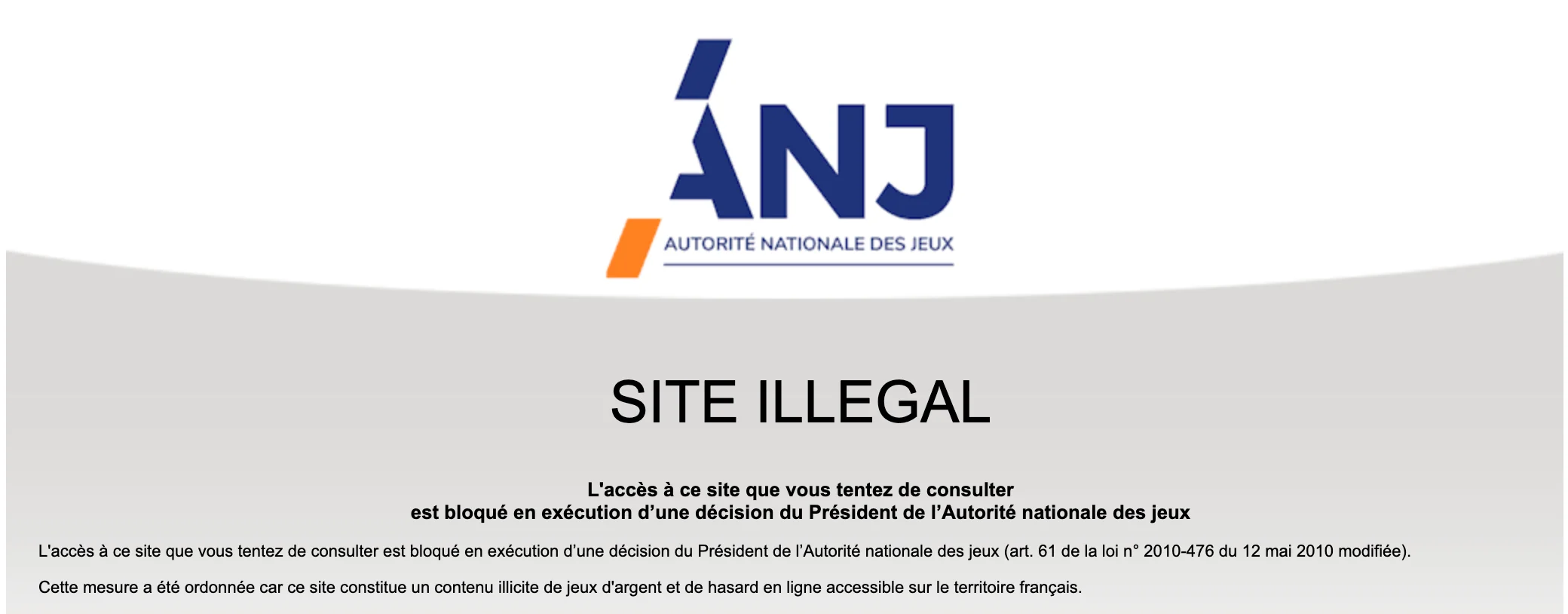
But the page is only the door. The bets don’t live there, but in a public ledger, copied onto computers all over the world, that no one can erase. The French authority itself admits that its previous block, the one from 2024, was being circumvented in practice.3 A country can shut down a website. It can’t shut down the technology behind it.
I like that story because it’s small and holds almost everything I want to tell. A technology that puts a price on any question about the world. Someone who wins if they get it right. A government that shows up late. And the temptation, when you can’t change the weather, to change the thermometer.
I don’t bet, not there and not anywhere else. But since Donald Trump’s election in 2024, I’ve been seeing the numbers from these markets everywhere: on X, on Google Finance next to the stocks, in a strip along the bottom of the screen on CNN, in the Wall Street Journal.4 And when a number shows up in so many places, it stops sounding like a bet. It starts sounding like data.
That step, from bet to data, is what interests me, and it wasn’t a company that took it: Polymarket is one of its causes, the most visible, but not the only one. It was taken by a technology that turned a very old idea, betting on the future, into infrastructure open to anyone, from any country, at any hour. And what’s changing is something everyday: how we find out what’s happening, how we talk about what’s going to happen and what we’re willing to believe.
Behind it lies a question, and it’s the one I want to think through here: what happens to our relationship with the truth, and with the world, when what we believe has a price.
I’m not writing this against the technology, or to call for regulating it. Whether it should be regulated, I don’t know: maybe yes, maybe no, and I’ll leave that question open. What I want is for what is already happening to be seen clearly.
The machine
A prediction market is a simpler machine than it looks. It isn’t a bookmaker, where the house sets the odds and pays you if you win: here, the people betting bet against each other. Each question has two shares, “Yes” and “No,” and when the answer is known, the one that was right pays a dollar and the other pays nothing. If the “Yes” share sells for 62 cents, it’s because someone is willing to pay 62 cents today for a dollar they will only collect if it happens. That’s the 62% that later shows up in the news. Nobody calculates it: it’s the point where those who want to buy meet those who want to sell.
The idea is old: more than a century ago, Wall Street brokers were already betting on presidential elections. What always held it back was the money, which had to be sent to someone with a bank, a license and a country that would let them operate. That was where any government could shut it down. Intrade, the largest market of the 2000s, stopped operating in 2013, a few months after the agency that regulates these markets in the United States sued it.5
That brake was released by three inventions that came with cryptocurrencies:
- A stablecoin. It’s a digital dollar that travels without going through a bank.
- A contract that isn’t a piece of paper, but a program. It holds the money and, on its own, pays whoever gets it right.
- A blockchain. It’s a public ledger copied onto computers all over the world, where every bet is recorded and that no one can alter.
With those pieces, betting no longer needed anyone’s permission. The first to try it was Augur, in 2018, a market that aimed to have no owner. Polymarket arrived in 2020 with a more practical version: buyers and sellers are matched on its own servers, but every bet is paid out and recorded on a blockchain.6
The proof that the machine is bigger than Polymarket lies in its main competitor, Kalshi, which was born as a licensed exchange in the United States. In 2024, one of its founders explained that they hadn’t built it on a blockchain because it wouldn’t have attracted the big investors that way. Since then, Kalshi has accepted digital dollars, hired a head of crypto and taken its markets to Solana, another blockchain.7 Even the one that had ruled out the technology ended up using its pieces.
One detail remains, and it matters more than it seems. The chain knows who paid whom, but not who won an election, because it can’t see the world. In 1990, when the economist Robin Hanson began proposing these markets, he noted that two things would be needed: a financial institution to “hold the stakes” and judges to decide the question.8 The blockchain replaced the institution with a program. The judges it hasn’t been able to replace: they are the oracle Buterin was asking for. There, where a system built so that no one has to trust anyone ends up trusting someone, is where much of what follows begins.
Believing with money
I studied philosophy, and there’s a page of Kant’s I’ve never forgotten. It comes near the end of the Critique of Pure Reason: to find out whether someone really believes what they assert, Kant says, the touchstone is a bet. Some people state their views with such confidence that they seem to have lost all fear of being wrong, and a bet unsettles them. Kant puts it in ducats, gold coins of his day: sometimes that confidence is enough to risk one, but not ten. They’ll risk the first without a second thought, and only at ten do they realize they might be wrong.9
For Kant, the bet was a way to put a person to the test. In the twentieth century, two mathematicians turned it into something much bigger: the very definition of probability. “The old-established way of measuring a person’s belief,” the Englishman Frank Ramsey wrote in 1926, “is to propose a bet, and see what are the lowest odds which he will accept.” In the market’s terms: if someone is willing to pay up to 62 cents for a share worth a dollar if a candidate wins, then for that person the probability that the candidate wins is 62%. Understood this way, probability isn’t calculated by looking at the world. It’s read in what each of us is willing to bet.
But Ramsey saw the problem with that measurement: proposing a bet to someone can change what they believe. The same thing happens, he wrote, when you measure an electric field by introducing a charge, because the charge alters the field you set out to measure.10 Measuring a belief can move it.
The Italian Bruno de Finetti took the idea all the way, and wrote the conclusion in capital letters: “PROBABILITY DOES NOT EXIST.” He wasn’t denying uncertainty. He meant that probability isn’t in the world, like the temperature in Berlin, but in the head of whoever holds the belief, and that treating it as a thing is “an illusory attempt to exteriorize or materialize our true probabilistic beliefs.”11 There’s no 62% chance of a candidate winning. There are people who believe, more or less strongly, that the candidate will win.
A prediction market does exactly what de Finetti called an illusion, and it does it in public. It gathers millions of beliefs, gives each one the weight of the money behind it and publishes them as a single figure under the name of “probability.”
What doesn’t exist appears on the screen, next to the stocks, as if it were data.
And sometimes it isn’t even a belief. For much of 2025, the largest crypto market gave the Second Coming of Christ about 3%. It isn’t that one in thirty bettors expected it. Betting that he wouldn’t return cost about 97 cents for every dollar collected at the end of the year: it was like lending your money for a few months in exchange for interest. According to Bloomberg, anyone who did it in April earned more than with US Treasury bills.12 The number that seemed to measure a faith was measuring the cost of money.
Kant used the bet to make you doubt yourself. The market uses it to make us stop doubting: what others believe reaches us as if it were a fact. And that leaves all of us facing a question: if we stop telling apart what people believe from what really happens, what is left of the truth? It isn’t an abstract question.
What the number measures
There’s a simple way to see what the number on these markets really measures: look at what moves it. In 2024 there were two attempts to kill Donald Trump, two months apart. If the number measured facts, both should have moved it in similar ways. They didn’t.
On Saturday, July 13, at 6:11 p.m., a twenty-year-old fired eight shots at Donald Trump from the roof of an industrial building during a campaign rally in Butler, Pennsylvania. One bullet grazed his right ear. Another killed Corey Comperatore, a former volunteer fire chief who was in the bleachers with his family. Trump got up with blood on his face, raised his fist and managed to shout “Fight, fight, fight” as Secret Service agents rushed him off the stage.13
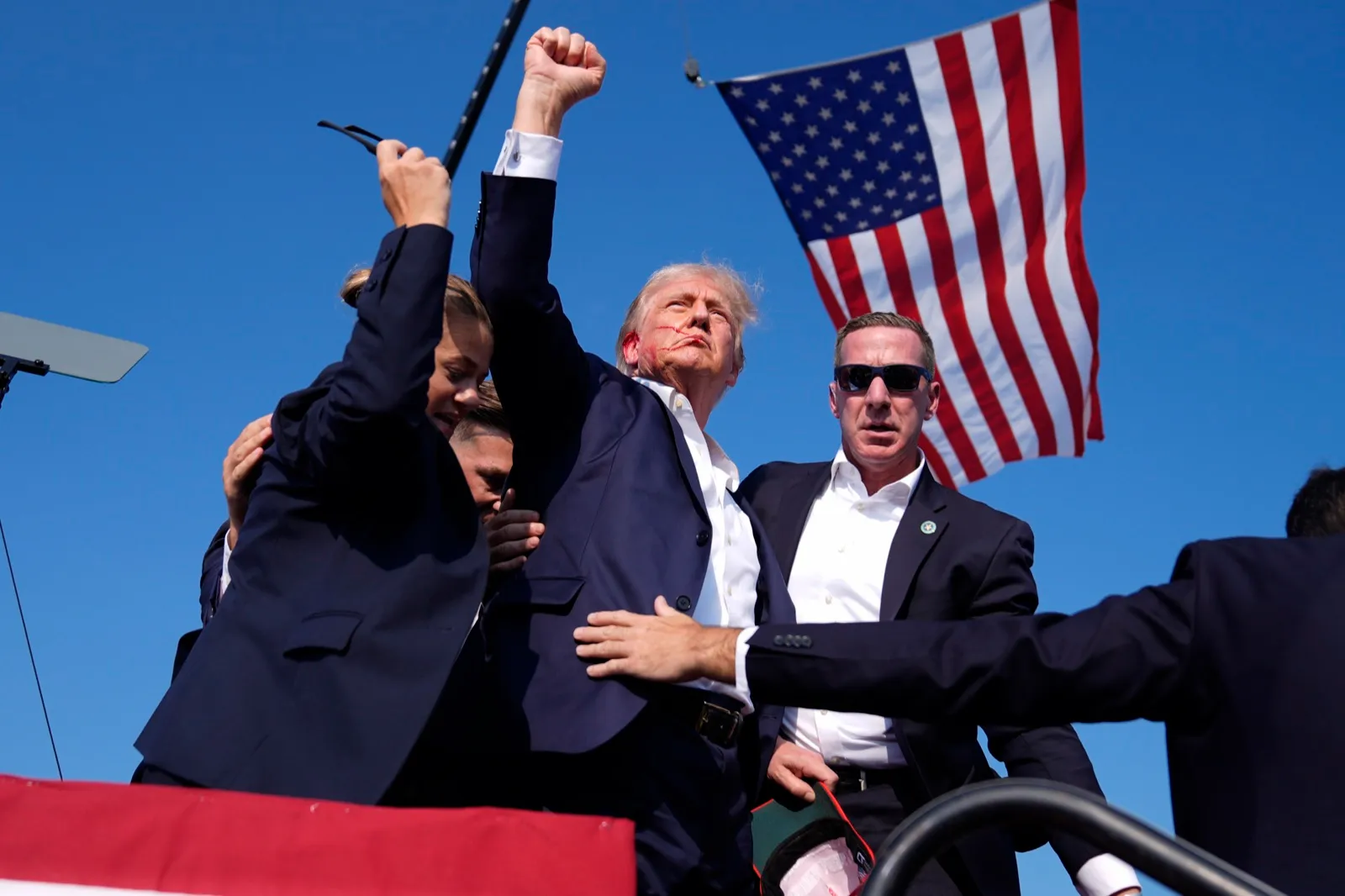
That night, on the largest crypto market, the share that paid a dollar if Trump won the election went from 60 to 70 cents. It had never been that high.14
Two months later, on September 15, a Secret Service agent spotted the barrel of a rifle in the bushes at Trump’s golf club in West Palm Beach, Florida, and opened fire. It was the second attempt on his life in the same campaign. This time there was no image of Trump that went around the world, and the number barely moved.15
Why did one move it and the other not? The number knew nothing about Trump’s ear. What it anticipated was what all of us would think when we saw the photo: the raised fist, the blood on his cheek, the flag behind him. Those who bet that night weren’t betting on a wound, but on the reaction of millions of people who hadn’t yet seen the image.
That changes how every percentage on these markets should be read. When we see that a candidate has 70%, the number seems to be talking about the world. It’s talking about us: about what people believe, or are about to believe. That night, the market wasn’t predicting an event. It was predicting a perception.
And because we all see that number at the same time, it doesn’t stop at anticipating what we’ll believe. It pushes it.
Defining the situation
The idea that what we believe ends up changing what happens isn’t new. In 1928, the sociologist William Thomas and his colleague Dorothy Swaine Thomas told the story of an inmate at Dannemora, a prison in New York State, who had killed several people who had “the unfortunate habit of talking to themselves on the street.” From the movement of their lips, he imagined they were insulting him, “and he behaved as if this were true.” They closed the paragraph with a sentence sociology has been repeating ever since:
If men define situations as real, they are real in their consequences.16
That is what this technology does. It doesn’t guess the future: it defines the situation. It gives what is going to happen a number that everyone sees at once, and that number, like the strangers’ lips for the Dannemora inmate, makes people act as if it were true. The sociologist Donald MacKenzie found something similar in finance. In the 1970s, a few economists published a formula for calculating the price of certain contracts traded on the stock market, and once traders started using it, market prices came to look more and more like what the formula said. The theory, MacKenzie wrote, had been “an active force transforming its environment, not a camera passively recording it,” and he put it in the title of his book: An Engine, Not a Camera.17 A prediction market presents itself as a camera that photographs the future. It works like an engine.
And it’s no accident. Back in 1990, Hanson was already proposing that the odds of these markets be taken “as a consensus for policy decisions.”8 In 2025, one of Kalshi’s founders said it without metaphors: “Kalshi is replacing debate, subjectivity, and talk with markets, accuracy, and truth.”18 From the start, this technology wanted a place in decision-making. Now it wants to take the place of debate.
It also arrived with four promises worth taking seriously, because they came true. It’s just that none turned out the way it was promised, and each one, as it came true, pushed the price one step further into the truth: first into what we expect, then into what we know, then into what happens and, in the end, into what happened.
- A market open to anyone. It is: with a digital dollar you can bet from any country and any phone. But what gets in isn’t the people, it’s the money electorate.
- A price that informs everyone. It delivered: the number leaves the market and becomes news, conversation, common sense. And a figure that everyone sees at once no longer just informs: it coordinates. That is the public probability.
- Bets with no cheating. In the contract there is none. The cheating moved outside, into the world the contract can’t see, and everything you can bet on (an election, a war, a pope, a word) became the prophecy for sale.
- That the truth would emerge on its own from the agreement of many. It does, but from a vote among the holders of the oracle’s tokens: the voted truth.
All four, each with a real case:
Each promise, one step further into the truth
- Into what we expect
The money electorate
Each dollar votes, not each person. In 2024 a single bettor, a Frenchman who goes by Théo, had more than $30 million riding on Trump.
- Into what we know
The public probability
A number everyone sees at once no longer just informs: it coordinates. In October 2024, Elon Musk posted on X that these markets were “more accurate than polls.”
- Into what happens
The prophecy for sale
If the number moves people, someone will want to buy it. Hours before Nicolás Maduro was captured, a newly opened account bet he would leave power, and won more than $400,000.
- Into what happened
The voted truth
When there’s a dispute, what happened is decided by a vote among the holders of the oracle’s tokens. In 2025 they voted that Volodymyr Zelensky’s black jacket was not a suit.
Anyone can bet
The oldest promise of these markets wasn’t invented by the blockchain: it’s the wisdom of the crowd. In 1907, the English scientist Francis Galton reported in the journal Nature that some eight hundred people at a fair in Plymouth had tried to guess how much an ox would weigh. If all the estimates were lined up from lowest to highest, the one in the middle was 1,207 pounds. The ox weighed 1,198. He titled his article Vox Populi.19 Forty years later, the economist Friedrich Hayek gave it the shape of a theory: knowledge is scattered across millions of heads, and the price is what brings it together.20 What the blockchain added was scale. Without a bank there’s no border, and without a border Galton’s crowd can be the whole world.
But that promise has a hidden premise: that the crowd doing the betting is the people. And it isn’t. In a market, it isn’t each person who votes. Each dollar votes, and only those who want to bet, and can, get a vote.
- ConceptThe money electorate
- The electorate of a prediction market. It isn’t each person who votes, but each dollar, and only those who want to bet, and can, get a vote. The price reflects what that electorate believes, not what people believe.
In 2024, these markets assembled a very particular electorate. Polymarket didn’t accept bettors from the United States, so the most cited number on the American election was made, at least in theory, by foreigners.21 And among them, one weighed more than anyone: a Frenchman who goes by Théo. At one point he had more than $30 million riding on Trump across four accounts, according to the Wall Street Journal, and he won between $50 million and $85 million.22 When asked about him, Polymarket gave the most honest answer I’ve read about these markets: they aren’t polls, because they measure the likelihood of an event, not what people intend to do.23 Polymarket is right. The number doesn’t say what people think. It says what bettors believe.
And not even within that electorate does the price belong to everyone. This year, four economists went through 1.7 million Polymarket accounts one by one, something only possible because the ledger is public, and found that about 3% are systematically right. That 3%, together with the intermediaries who are always willing to buy and sell, takes more than 30% of the profits. “The remaining majority does not produce accuracy,” they concluded; “rather, it funds it.”24 The number reflects what a few who know believe, paid for by the many who think they know.
The electorate also has a face: it is mostly male and young. According to an Ipsos survey this year, 8% of American men aged 18 to 24 had used one of these markets in the previous six months, compared with 3% of all Americans.25 And it doesn’t bet so much on politics as on sports: according to a federal court, more than 90% of Kalshi’s trades in 2025 were on sports, even in states where the law bans betting on them.26
Most of them lose. On the largest crypto market, seven in ten accounts that seem to be run by people are in the red. The ones that win, taken together, are the ones that look like automated programs.27 In the states that legalized online sports betting, according to two studies published this year, households invest less, borrow more and bankruptcies rise. And in the United States, the national helpline for people with gambling problems now has a new category: prediction market betting.28
Why do they bet? The French sociologist Roger Caillois said that games of chance are “an insolent and sovereign mockery of merit.”29 For a generation that feels merit is no longer enough, that mockery is appealing: early this year, 80% of Gen Z told a survey that they felt financially behind and that speculative investments do more for them than traditional ones.30 It already has a name: financial nihilism, the feeling that saving no longer gets you anywhere and that all that’s left is to bet.
There’s something else, which doesn’t show up in any study. In an election, each citizen has one vote and uses it to decide. In a market, each person has their money and uses it to guess.
They are two ways of facing the future: one makes it, the other prices it.
And in the same app where an election is priced, so are an American football game, tomorrow’s weather and the next pope, with the same screen and the same gesture: buy or sell. In there, an election becomes just another game.
In that game, what’s probable is no longer decided by people. It’s decided by money.
The price informs
None of this would matter much if the number stayed in the market. But the second promise is precisely that it gets out. Four days after the 2024 election, Buterin put it this way: a market like Polymarket is a betting site for those who take part, and “a news site for everyone else.”31
That promise had been kept once before. Between 1884 and 1940, the New York Times published Wall Street’s betting odds on presidential elections almost daily,32 and even then people suspected that a candidate’s supporters inflated them to sway votes.33 If people believe the number, moving the number moves the people. What finally pushed those markets out of the paper were George Gallup’s polls, which from 1936 on offered a number with a scientific method and without the moral stain of gambling.34
Eighty-odd years later, the number came back to the paper without the stain: no longer as a bet, but as information. In October 2024, Elon Musk posted on X that betting markets were “more accurate than polls, as actual money is on the line,” and when Trump won, a story took hold: the markets had seen what the polls hadn’t.35
Then came everything else. X made Polymarket its official partner, Google put the odds next to the stocks, and CNN and three other networks signed with Kalshi.36 In one of its segments, CNN showed a market that gave Trump a 43% chance of acquiring part of Greenland, even by force, and presented it as proof that people were taking the idea seriously. According to a later analysis, a few days earlier that number had risen from 30% to 39% on just $24,000 in bets.37
Polymarket called its own news site The Oracle,38 and this year, on its home page, it stopped inviting people to profit “by betting” and started inviting them to profit “by trading.”39 The Dutch historian Johan Huizinga had already noticed it in 1938: you play at roulette and you “play the market,” and the difference in mental attitude is minimal.40
And the number didn’t just reach the media. It also reached the power this technology had promised to get around. In 1988, the engineer Timothy May announced in a manifesto that cryptography would make it possible to trade completely anonymously and that this would “alter completely the nature of government regulation.”41
Thirty-odd years later, the technology arrived and turned the manifesto upside down. The US regulator fined Polymarket in 2022 for operating without a license,42 and in 2025, with Trump back in the White House, the investigations were closed without charges and the company returned to the United States through the front door.43 The company that owns the New York Stock Exchange took a fifth of Polymarket and a seat on its board,44 and its latest funding round was led by the fund in which Donald Trump Jr., the president’s eldest son, is a partner.45
Behind Polymarket came Kalshi, which today handles most of the money, the crypto exchanges, the investing app Robinhood, the big sportsbooks and even the Chicago exchanges and Nasdaq.46 Robinhood’s CEO presented its prediction market as “the application of capitalism to the pursuit of truth.”47 Together they moved about $16 billion in 2024, and more than $380 billion so far in 2026, almost all of it on sports.48
A technology born to operate outside banks and governments ended up with the owner of the New York Stock Exchange on the board of its best-known company and the fund of the president’s son among its investors. With that backing, the number no longer looks like a bet: it looks like official data. In France, by contrast, anyone who spreads its odds to promote an unauthorized site risks a €100,000 fine.3 The same number is news in New York and illegal advertising in Paris.
And a number that everyone sees at the same time no longer just informs: it coordinates. I don’t just know that the market gives Trump 62%; I know that you know it, and that you know I know it. The sociologist Robert Merton summed it up in 1948: the public definition of a situation becomes part of the situation. Predicting the return of Halley’s comet doesn’t change its orbit.49 Predicting an election can change it, above all because no one reads the number for what it is: a bet. “People see a seventy percent chance, and they round that up to a hundred,” an editor who specializes in elections told the Columbia Journalism Review.50
That’s how we find out about the world today: in percentages, and rounded up.
- ConceptThe public probability
- A number about the future that everyone sees at the same time and that gets quoted as data. It no longer just informs: it coordinates, because each person knows the others are looking at it.
No one can cheat
Buterin noted down another promise in 2014, and it’s the one that was kept best: gambling services that “have no ability to cheat.”1 The program, indeed, doesn’t cheat. The cheating moved outside, into the world the contract can’t see. The philosopher Karl Popper had given a name in 1957 to what makes it possible: the “Oedipus effect,” the influence of a prediction on what it predicts. In the myth, an oracle tells Oedipus’s father that his son will kill him; the father abandons him at birth, and that is why, years later, Oedipus kills him without knowing who he is.51 If a number can move what it predicts, someone will want to buy it. There are three ways:
Moving the number. It’s the cheapest, and Buterin himself warned about it: if everyone trusts the charts, anyone with money can manipulate them, and no one will dare to bet against them.31
Knowing in advance. It’s subtler, and the technology smooths the way, because on the crypto markets that operate outside the United States you generally don’t have to give your name. In January, hours before US forces captured Nicolás Maduro, a newly opened account bet about $33,000 that he would leave power before the end of the month, when the market put that at 7%, and won more than $400,000. In April, US authorities charged a special forces soldier who had taken part in the operation with placing that bet using secret information. He pleaded not guilty.52 And in August, the regulator fined Trump’s teleprompter operator, who had bet on the words the president was going to say.53 A market that pays people for that isn’t discovering information. It’s buying secrets. “The whole world, unfortunately, has become somewhat of a casino,” Trump said when asked about officials who profit from these markets.54
Making it happen. It’s the darkest. One of the first people to imagine a betting market with digital money imagined it for exactly that. Between 1995 and 1996, a crypto-anarchist named Jim Bell proposed an anonymous market where anyone could bet on the date a government official would die, and where the person best placed to get it right was, of course, the one who saw to it that it happened. Bell knew what his idea depended on: it was merely waiting, he wrote, for “the triad of the Internet, digital cash, and good encryption.”55 In 2018, Augur already had markets on whether Trump would be assassinated, and no one could delete them.56 Today the big markets don’t offer them, and US law bans them on regulated exchanges.57 But the edge is blurry: when rumors about Trump’s health circulated in 2025, markets opened on whether he would leave the presidency, and the rules of one of them didn’t exclude death.58 And what can’t be caused on a large scale is caused on a small one. An airport thermometer, for example.
- ConceptThe prophecy for sale
- A public prediction that someone can buy instead of getting it right: by moving the number to move people, by knowing in advance what no one else knows or by making what was predicted happen.
But cheating isn’t the deepest part. Something changes even if no one cheats, and the philosopher Michael Sandel explained what: markets don’t just distribute things, they also express a way of valuing them, and putting a price on something means deciding, even if no one says so, that it’s fine to treat it as a commodity.59
Look at what gets priced today. On February 24, 2025, with Pope Francis in a hospital in Rome, Polymarket opened a market on his successor and announced it with a joke: now, with a simple digital signature, “you can not only jeopardize your money, but also your soul.” On the day Francis died another one appeared, on whether the next pope would be shorter than five feet eight inches, and the company’s newsletter dismissed the death in a single line: “markets are forward looking, so let’s not dwell on that.”60 In 1591, Pope Gregory XIV had banned betting on conclaves, on pain of excommunication.61
Private life is priced too: there are markets on Taylor Swift’s wedding, from the venue to the bridesmaids and the guests.62 And words are priced. One market was taking bets on which words the CEO of Coinbase, the largest cryptocurrency exchange in the United States, would say on a call with investors. He closed the call like this: “And I just want to add here the words Bitcoin, Ethereum, Blockchain, Staking, and Web3.”63 When a word has a price, people stop listening to a speech to understand it and start listening to collect on it.
Most people still sense this: in a Reuters/Ipsos poll this month, 60% of Americans opposed betting on elections, and 65% on military action.64 Sandel wrote about a market for betting on terrorist attacks that the Pentagon came close to opening in 2003. What he feared was that this intuition would wear out with use: when markets in death become familiar and routine, he warned, the revulsion is not easy to keep.65
And when everything is quoted, even what is going to happen can be bought.
The truth is what’s obvious
Every market ends with a question that seems trivial: what happened? But the contract can’t see the world, so someone has to tell it. Programmers call this the oracle problem, and Buterin proposed solving it with many: have several people report the data and reward the ones who land in the middle. “Everyone has the incentive to provide the answer that everyone else will provide,” he wrote, “and the only value that a large number of players can realistically agree on is the obvious default: the truth.”1
Polymarket uses an oracle called UMA, which runs on a version of that idea. Someone proposes the answer, and if no one disputes it, it stands. If someone does, it goes to a vote among the holders of UMA’s token, the oracle’s own cryptocurrency: each voter counts for as many tokens as they hold, and anyone who votes differently from the majority loses part of them. “There’s no single source of truth,” its documentation says, “just the consensus of honest participants acting in their own best interest.”66 A voter’s interest, then, isn’t to vote for what happened, but for what they think everyone else will vote for. It’s the beauty contest described by the economist John Maynard Keynes: the winner isn’t the prettiest face, but the one each person thinks the others will pick.67 Almost always, the vote matches what happened. When it doesn’t, it shows.
In July 2025, a market worth more than $100 million asked whether Volodymyr Zelensky would wear a suit. Since the Russian invasion, Ukraine’s president has dressed in military-style clothing. He showed up at a summit in a black jacket that several media outlets described as a suit, and UMA’s voters decided it wasn’t one.68 The fight wasn’t about the future, but about a word. When there’s money at stake, the obvious stops being obvious.
The philosopher Hannah Arendt wrote in 1967 that “freedom of opinion is a farce unless factual information is guaranteed and the facts themselves are not in dispute.” Facts, she explained, depend on witnesses, and once they are lost, no rational effort brings them back.69 Kalshi says it is replacing debate with truth. In these markets the opposite happens.
The truth becomes the last debate, and it’s won with tokens.
Sometimes the fight isn’t over the facts, but against whoever reports them. In March, Polymarket had a market on whether Iran would strike Israeli soil on the 10th, and under its rules an intercepted missile didn’t count. That day, Emanuel Fabian, a reporter for the Times of Israel, reported that an Iranian missile had fallen in an open area. His story backed the yes, and those who had bet on no stood to lose. They started messaging him to make him write that the missile had been intercepted. “86 minutes left,” one of the messages said. “You are the only one responsible for your life.”70
In elections, the biggest witness of all is the Associated Press. In 2024 it was one of the three sources that, under Polymarket’s rules, decided who had won the presidential election. Today it sells Kalshi its real-time vote counts.71 The one that decides who won sells its verdict to the one that bets on who wins.
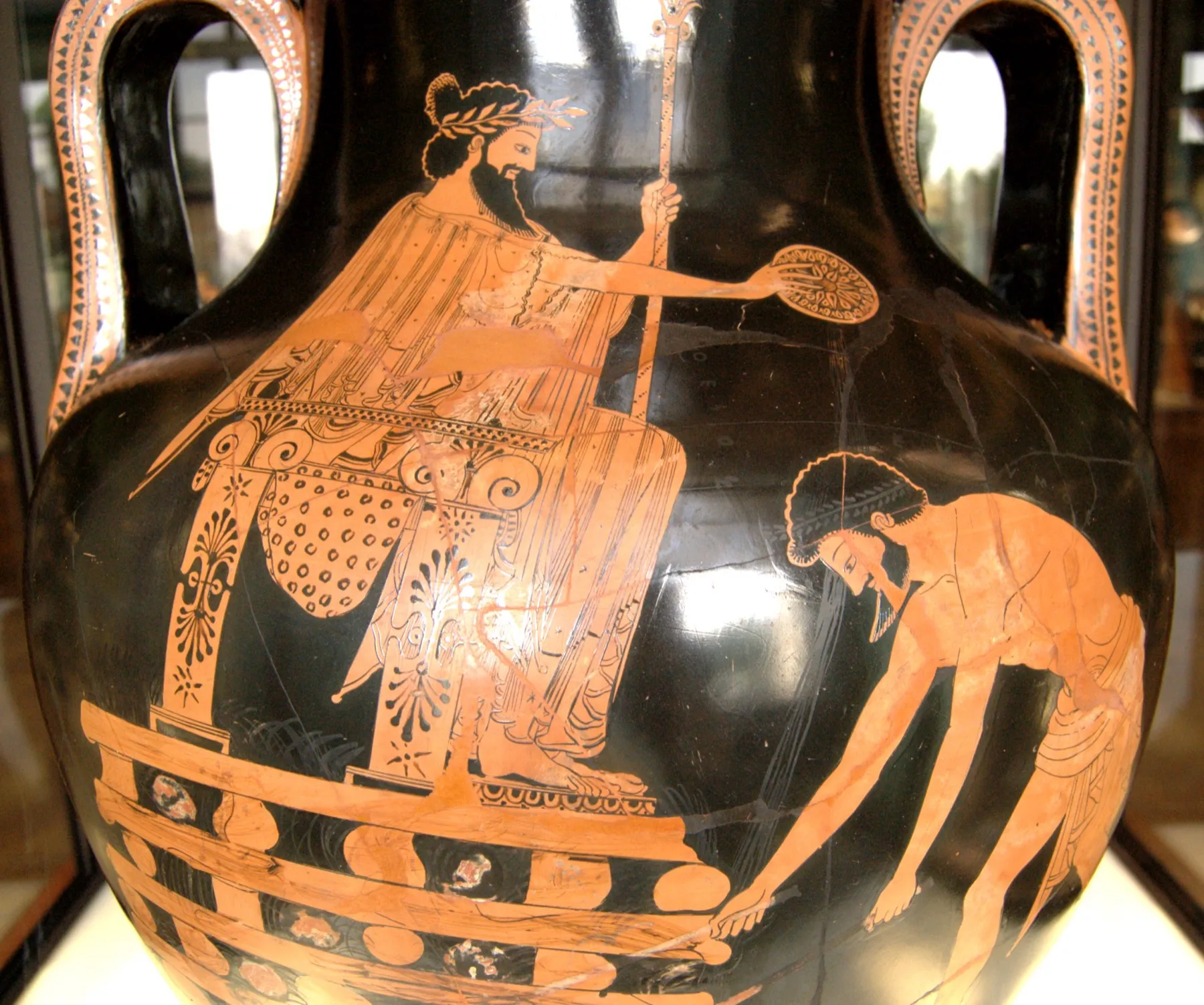
The oracle at Delphi knew this problem well. Herodotus tells how Croesus, king of Lydia, asked it whether he should attack the Persians, and the Pythia, the priestess through whom Apollo spoke, answered that, if he did, he would destroy a great empire. He attacked, and destroyed his own. When he sent to complain, the oracle replied that the fault was his, for not having asked which empire it meant.72 The oracle was never wrong, because it reserved the right to say, afterward, what it had meant. That’s what happens with a market’s rules when there’s a dispute: someone decides, afterward, what the rules meant. The difference is that at Delphi the priests decided, and on the blockchain, whoever holds the most tokens.
Although, if you read the code, the blockchain has priests too. The program that connects Polymarket to its oracle lets an administrator decide a market’s outcome by hand, and the documentation for its new contracts calls the oracle operator “a fully trusted role,” one the company itself runs.73 The system invented so that you wouldn’t have to trust anyone ends up asking you to trust someone.
In the end, even what already happened is decided with tokens.
- ConceptThe voted truth
- The verdict of a prediction market when there’s a dispute. What happened isn’t decided by a disinterested judge, but by a vote among token holders, in which each one counts for as much as they hold.
What the number does to the truth
The most visible part of this change isn’t in the markets. It’s in how we live the news. An election, a war or a pope’s health no longer reach us only as facts: they reach us with a percentage next to them, and that percentage changes how they feel. A 70% feels like something already settled, even though three times out of ten it doesn’t happen. A jump of a few points feels like news, even when a few thousand dollars moved it.
Watching the world this way is like watching a game. There’s a scoreboard that goes up and down with every piece of news, and we follow it like fans: with relief, with anxiety, with the feeling that something is being played out right now. What gets lost is the pause between finding something out and deciding what to think. By the time we get there, the number has already thought for us.
And the question we ask changes. Faced with something we didn’t know, we used to ask whether it was true. Now, more and more, we ask what it pays. The truth stops being something you find out and becomes something that is quoted, voted on and, sometimes, bought.
That has an end point, and in 2024 someone already saw it coming. If Trump lost, an investor feared, the bets that had him winning would be used to say the election had been stolen.74 Trump won, and no one had to use them. But the idea is on record: that a number about what people believe could weigh more than the votes that were actually counted.
I go back to the thermometer in Paris. Maybe no one heated it. But that image says what is at stake: when you can’t change the weather, the temptation is to change the thermometer. The same goes for the truth. When what we believe has a price, there’s no need to change the facts anymore. It’s enough to move the number.
References
-
Vitalik Buterin, Ethereum: A Next-Generation Smart Contract and Decentralized Application Platform, published in 2014, before Ethereum launched. In the list of applications: “A decentralized data feed,” with SchellingCoin, which could report “the ETH/USD price, the temperature in Berlin or even the result of a particular hard computation” (“Everyone has the incentive to provide the answer that everyone else will provide, and the only value that a large number of players can realistically agree on is the obvious default: the truth”); “Peer-to-peer gambling” (“gambling services with near-zero fees that have no ability to cheat”); and “Prediction markets”: “Provided an oracle or SchellingCoin, prediction markets are also easy to implement.”
-
Bobby Allyn, “French police probe suspected weather device tampering after odd Polymarket bet,” NPR, April 23, 2026: the bet was that the temperature would exceed the equivalent of 64 °F, and Bubblemaps found the spike at no other station. Polymarket switched to resolving its Paris markets with the Le Bourget station. The investigation by the cybercrime section of the Paris prosecutor’s office was opened on May 4, 2026, according to the ANJ (next note).
-
The
offre-illegale.anj.frpage, to which polymarket.com resolved from a French connection on October 19, 2026. Autorité nationale des jeux, “Promotion d’une offre de jeux d’argent illégale : blocage du site Polymarket”, July 17, 2026: the blocking order is dated July 16; among its reasons, that the 2024 geoblock was being circumvented, that the site doesn’t verify its users’ identities and that the weather bets had revealed that weather probes might have been hacked. The same statement recalls the €100,000 fine for anyone who spreads the odds of an unauthorized site to promote it. Translations from the French are mine. -
On X: TechCrunch, June 6, 2025. On CNN: Axios, December 2, 2025. On Google Finance (November 6, 2025) and Dow Jones (January 7, 2026): The Block.
-
Commodity Futures Trading Commission, press release 6423-12, November 26, 2012. Intrade suspended operations on March 10, 2013.
-
Polymarket documentation (consulted on the Internet Archive, October 2026): the order book is “hybrid-decentralized,” with matching off the chain and settlement on it; the shares follow Gnosis’s Conditional Token Framework, and since April 2026 the collateral has been pUSD, backed by USDC.
-
Leo Schwartz, Fortune, October 28, 2024: the USDC deposits and the explanation by Tarek Mansour, a cofounder of Kalshi (“We didn’t really see a viable business that way for us if you want to attract institutional participation”). On John Wang: RT Watson, The Block, August 25, 2025 (“leading the push onchain”). The tokenization on Solana, with DFlow and Jupiter: Nitesh Nath, solana.com, and Daniel Kuhn, The Block, December 1, 2025. Kalshi’s order book is still off the chain: what lives on Solana is a mirror of its contracts.
-
Robin Hanson, “Market-Based Foresight: a Proposal”, Foresight Update, no. 10, October 30, 1990: “I propose we create markets where anyone can bet on controversial scientific and technological facts, and that we take the market odds as a consensus for policy decisions”; those who created each market would choose “a procedure for selecting judges to decide the question […] and a financial institution to ‘hold the stakes.’”
-
Immanuel Kant, Kritik der reinen Vernunft, “Vom Meinen, Wissen und Glauben,” A 824–825 / B 852–853 (Akademie-Ausgabe, III, 534): “Der gewöhnliche Probirstein, ob etwas bloße Überredung, oder wenigstens subjective Überzeugung, d. i. festes Glauben, sei, was jemand behauptet, ist das Wetten. […] Eine Wette macht ihn stutzig. Bisweilen zeigt sich, daß er zwar Überredung genug, die auf einen Dukaten an Werth geschätzt werden kann, aber nicht auf zehn besitze.” In English, in Paul Guyer and Allen W. Wood’s translation, Critique of Pure Reason (Cambridge University Press, 1998), p. 686. The paraphrase is mine.
-
Frank P. Ramsey, “Truth and Probability” (1926), in The Foundations of Mathematics and Other Logical Essays (London, Kegan Paul, 1931), section “Degrees of Belief,” p. 172: “The old-established way of measuring a person’s belief is to propose a bet, and see what are the lowest odds which he will accept. […] Besides, the proposal of a bet may inevitably alter his state of opinion; just as we could not always measure electric intensity by actually introducing a charge and seeing what force it was subject to, because the introduction of the charge would change the distribution to be measured.”
-
Bruno de Finetti, Theory of Probability, vol. 1 (London and New York, Wiley, 1974), preface dated Rome, July 16, 1973: “My thesis, paradoxically, and a little provocatively, but nonetheless genuinely, is simply this: PROBABILITY DOES NOT EXIST. […] Probability, too, if regarded as something endowed with some kind of objective existence, is no less a misleading misconception, an illusory attempt to exteriorize or materialize our true probabilistic beliefs.” It is the English edition of Teoria delle probabilità (Turin, Einaudi, 1970); the capitalized motto was written for it.
-
Polymarket’s “Will Jesus Christ return in 2025?” market was created on March 20, 2025, and resolved “No,” with $3,267,970 in volume; “Yes” stood between 3.6% and 2.95% until June (Internet Archive captures). Denitsa Tsekova and Isabelle Lee, Bloomberg, January 2, 2026: buying “No” in April returned 5.5% annualized before fees, more than Treasury bills. The explanation in terms of the cost of tying up the money had been given earlier by Eric Neyman, “Will Jesus Christ return in an election year?”, March 24, 2025.
-
House Task Force on the Attempted Assassination of Donald J. Trump, final report, December 2024.
-
Marc Hochstein, “Trump’s Odds of Victory Hit All-Time High on Polymarket After Shooting”, CoinDesk, July 13, 2024, 9:05 p.m. (Eastern time): the market then had $252 million in bets. It wasn’t only on Polymarket: on PredictIt, Trump’s share went from 60 to 69 cents between July 12 and 15 (Fortune, September 16, 2024).
-
Paolo Confino, Fortune, September 16, 2024: “Prediction markets haven’t budged.” Polymarket had Harris at 50% and Trump at 49%, as it had since September 12. According to CoinDesk (Sam Reynolds, September 16, 2024), Trump’s chances even fell in the hours that followed.
-
William I. Thomas and Dorothy Swaine Thomas, The Child in America: Behavior Problems and Programs (New York, Knopf, 1928), chapter XIII, pp. 553 and 572.
-
Donald MacKenzie, An Engine, Not a Camera: How Financial Models Shape Markets (Cambridge, Massachusetts, MIT Press, 2006), ch. 1: financial economics was “an active force transforming its environment, not a camera passively recording it.” The title inverts a phrase by Milton Friedman (1953), for whom theory was an engine to analyze the world, “not a photographic reproduction of it.”
-
Kalshi press release of December 2, 2025, on its $1 billion round at an $11 billion valuation (Business Wire): “Kalshi is replacing debate, subjectivity, and talk with markets, accuracy, and truth.”
-
Francis Galton, “Vox Populi”, Nature, 75 (March 7, 1907), pp. 450–451. There were 787 legible tickets.
-
Friedrich A. Hayek, “The Use of Knowledge in Society,” American Economic Review, 35, no. 4 (1945), pp. 519–530: the tin example and the quotation, on p. 526.
-
Polymarket blocked US users to comply with the CFTC’s 2022 order (The Block, January 24, 2022). In November 2024, US authorities were investigating whether Americans had bet anyway.
-
Alexander Osipovich, “The Trump-Betting Whale Speaks Out,” The Wall Street Journal, November 1, 2024, and “How the Trump Whale Correctly Called the Election”, November 6, 2024. Estimates of the winnings range from nearly $50 million (WSJ) to $78.7 million (Chainalysis) and $85 million (Joe Nocera, The Free Press, November 26, 2024), which also speaks of eleven accounts.
-
Polymarket statement quoted by Kevin Breuninger, CNBC, October 24, 2024.
-
Roberto Gómez-Cram, Yunhan Guo, Howard Kung and Theis Ingerslev Jensen, “Prediction Market Accuracy: Crowd Wisdom or Informed Minority?” working paper on SSRN, April 2026. Anna Louie Sussman, “Wisdom of the Few?”, Yale Insights, June 10, 2026.
-
American Institute for Boys and Men and Ipsos, KnowledgePanel survey (n = 2,363), February 27 to March 1, 2026, published on March 17 (questionnaire and results): 3% of Americans and 8% of men aged 18 to 24 had used a prediction market in the previous six months, and 61% see them as “closer to gambling” than to investing (8%). Reuters/Ipsos, October 2026 (n = 4,506): 7% have bet on one at some point, and 75% believe it is a form of gambling.
-
KalshiEX v. Assad, US Court of Appeals for the Ninth Circuit, no. 25-7516, August 28, 2026 (opinion): “Over 90% of Kalshi’s trades in 2025, representing 95% of its revenue, were sports related” and “The substance of the sports event contracts offered on Kalshi’s DCM is sports gambling, regardless of whether Kalshi calls them swaps.” The opinion also quotes Kalshi’s advertising: “the first app for legal sports betting in all 50 states.” The example of California, where sports betting is illegal, is in Blue Lake Rancheria v. Kalshi, Ninth Circuit, September 16, 2026.
-
Will Owens, Galaxy Research, October 1, 2026 (report): of 2.9 million Polymarket retail accounts with a human cadence, 69.2% are below break-even, with losses of $338.9 million; the accounts that look like automated programs made $246.8 million. On Kalshi, retail users lost $583.5 million between July 2021 and May 2026, 64% of it on sports (Roosevelt Institute, July 7, 2026).
-
Scott R. Baker et al., Journal of Financial Economics, 183 (2026), 104330: with online sports betting, households’ net investment falls by about 14%. Brett Hollenbeck, Poet Larsen and Davide Proserpio, Management Science, online since July 21, 2026: with online access, credit scores drop by about 12 points, and bankruptcies, debts sent to collections and delinquencies rise. National Council on Problem Gambling, 2025 annual report of the national helpline, May 22, 2026: the “Prediction Market Betting” category appears for the first time, and 49% of contacts were between 18 and 34.
-
Roger Caillois, Les jeux et les hommes (Paris, Gallimard, 1958; revised edition, 1967), Folio edition, pp. 56–57: “l’alea nie le travail, la patience, l’habileté, la qualification […]. Il apparaît comme une insolente et souveraine dérision du mérite.” The translation is mine.
-
Northwestern Mutual, 2026 Planning & Progress Study, survey by The Harris Poll (n = 4,375, January 5 to 21, 2026), published on March 9, 2026: 80% of Gen Z feel behind and believe speculative investments serve them better than traditional ones (73% of all adults), and 32% invest or plan to invest in “sports betting / prediction markets.” The term financial nihilism was put forward by Demetri Kofinas on his podcast Hidden Forces in February 2020.
-
Vitalik Buterin, “From prediction markets to info finance”, November 9, 2024: “The two faces of Polymarket: a betting site for the participants, a news site for everyone else”; “If you are not a bettor, then you can read the charts, and for you it’s a news site”; the market “outputs predictions about the future as a public good”; “if everyone trusts the charts, then anyone with money can manipulate the charts and no one will dare to bet against them”; and, on governance, “the market is the ‘engine’, and some other non-financialized trustworthy mechanism is the ‘steering wheel.’”
-
Paul W. Rhode and Koleman S. Strumpf, “Historical Presidential Betting Markets”, Journal of Economic Perspectives, 18, no. 2 (2004), pp. 127–129. In 1916, some $165 million in 2002 dollars was wagered. The Times quotation is from September 28, 1924.
-
Rhode and Strumpf (2004), pp. 139–140. In May 1924, moreover, the New York Stock Exchange and the Curb barred their members from election betting, and in 1939 New York legalized betting on horse races.
-
Elon Musk, post on X, October 7, 2024 (the night of October 6 in New York). Polymarket then showed 50.6% to 48.4% (The Block). Hiawatha Bray, The Boston Globe, November 8, 2024, quoting Thomas Miller.
-
On CNBC (December 4, 2025), Fox (April 7, 2026) and CBS (September 30, 2026): The Block and Covers; on CNN, see an earlier note.
-
Aaron Rupar and Judd Legum, “How Kalshi infects the news”, Public Notice, July 6, 2026: at least 115 “The Odds” segments on CNN since December 2025; the one of January 7, 2026, on Greenland cited a Kalshi market in which the probability that the United States would buy part of the island before the end of Trump’s term had gone from 12% to 36% in six days, and another that gave a 43% chance that Trump would acquire part of it by any means, including militarily. According to the authors’ analysis of Kalshi data, that second market had risen from 30% to 39% between January 3 and 5 on just $24,000 in bets on “yes.” CNN replied that the odds are “just one source of data.”
-
Substack announced the launch of The Oracle by Polymarket on July 29, 2024. Its latest issue, from October 14, 2026, is titled “NEW WAYS TO LOSE.”
-
Internet Archive captures of polymarket.com from February 15, 2026 (“profit from your knowledge by betting on future events”) and March 1, 2026 (“by trading on future events”). The slogan “Trade on anything” appears in the structured data of kalshi.com in the captures of February 1 and May 2, 2026.
-
Johan Huizinga, Homo ludens (1938), ch. III, in Verzamelde werken, V (Haarlem, Tjeenk Willink, 1950), pp. 80–81: “Men speelt aan de roulette-tafel, en men ‘speelt aan de beurs’. […] Het onderscheid van mentale houding is uiterst gering.” On the same page he notes that futures trading and life insurance were born as bets, and he cites the Genoa decree of 1467: “ne assecuratio fieri possit super vitam principum et locorum mutationes.” The translation is mine.
-
Timothy C. May, “The Crypto Anarchist Manifesto”, written in mid-1988 and handed out at the Crypto ’88 conference; May posted it to the cypherpunks mailing list on November 22, 1992: “A specter is haunting the modern world, the specter of crypto anarchy”; “These developments will alter completely the nature of government regulation, the ability to tax and control economic interactions […]”; “An anonymous computerized market will even make possible abhorrent markets for assassinations and extortion.”
-
CFTC, press release 8478-22, January 3, 2022: a $1.4 million fine for offering binary options on events outside a registered market.
-
Dan Mangan, CNBC, July 15, 2025. The purchase of QCEX was announced on July 21, 2025.
-
Intercontinental Exchange, Form 8-K, October 7, 2025, and Form 10-Q, July 30, 2026: about 22% of the outstanding shares. In the press release of October 7, 2025: “ICE and Polymarket have also agreed to partner on future tokenization initiatives.”
-
Bloomberg, August 31, 2026. On Trump Jr. as an adviser to both companies: Molly White (2025).
-
Coinbase, with Kalshi as its provider, since December 17, 2025 (Fortune), and in all 50 states since January 28, 2026 (The Block); Crypto.com, with regulated sports contracts since December 23, 2024 (PYMNTS); Gemini Predictions, since December 15, 2025 (Gemini). Robinhood closed the purchase of the MIAXdx exchange, together with Susquehanna, on January 20, 2026 (Robinhood). CME Group and FanDuel announced their partnership on August 20, 2025 (FanDuel), and DraftKings Predictions launched on December 19, 2025, also on CME (InGame). Cboe presented its framework on March 9, 2026 (Cboe), and Nasdaq sought approval for its binary options on the Nasdaq-100 on March 2, 2026 (SEC, Release 34-104966).
-
Data from The Block (takers’ notional volume), consulted on October 19, 2026. Other measurements, in cash terms, give considerably smaller figures. Since July 2024, sports have made up 80% of Kalshi’s volume and 39% of Polymarket’s, and politics 4% and 32% (Pew Research Center, May 27, 2026).
-
Robert K. Merton, “The Self-Fulfilling Prophecy,” The Antioch Review, 8, no. 2 (1948), pp. 193–210: the bank example, on p. 194; the public definition and the comet, on p. 195. Merton attributes the Thomases’ sentence to William alone.
-
Nathaniel Rakich, editor at Votebeat, quoted by C. J. Robinson, “A Bet Is Not a Poll”, Columbia Journalism Review, May 7, 2026: “People see a seventy percent chance, and they round that up to a hundred.”
-
Karl R. Popper, The Poverty of Historicism (Boston, Beacon Press, 1957), § 5, p. 13. The book appeared in 1957, based on articles published in Economica in 1944 and 1945.
-
CFTC, press release 9217-26, April 23, 2026; Bobby Allyn, NPR, April 23, 2026. On the bets: Fortune, January 5, 2026, and The Block, January 3, 2026. The figures for the amount wagered vary between $32,000 and $34,000 depending on the source.
-
CFTC, press release of August 28, 2026; Reuters, July 16, 2026.
-
Jim Bell, “Assassination Politics”, written between 1995 and 1996 and published in installments: the commissioner quotation is from part 2, and the one about the triad (“the triad of the Internet, digital cash, and good encryption”), from part 7.
-
17 CFR § 40.11, which bars registered markets from listing any contract that “involves, relates to, or references terrorism, assassination, war, gaming.” On Kalshi: Molly White, Citation Needed, September 2, 2025.
-
Molly White, Citation Needed, September 2, 2025: nearly $1.5 million was wagered across the two markets.
-
Michael J. Sandel, What Money Can’t Buy: The Moral Limits of Markets (New York, Farrar, Straus and Giroux, 2012), p. 9: “markets don’t only allocate goods; they also express and promote certain attitudes toward the goods being exchanged” and “when we decide that certain goods may be bought and sold, we decide, at least implicitly, that it is appropriate to treat them as commodities, as instruments of profit and use.” The paraphrase is mine.
-
Polymarket’s “Who will be the next Pope?” market opened on February 24, 2025, and closed with $30,143,337 in volume; on May 8, before the white smoke, Prevost stood at 2.3% (Internet Archive captures). On Kalshi, his last trade before the announcement was at one cent (Kalshi’s public API). Polymarket newsletter of February 24, 2025, “How To Get Excommunicated on the Blockchain”: “you can not only jeopardize your money, but also your soul with a simple Metamask signature.” The market “Will the next Pope be a manlet?” (under 5 feet 8 inches) was created on April 21, 2025, the day Francis died; that day’s newsletter, “Manlet Pope?”: “Pope Francis’ death on Easter Sunday caught traders off guard. But markets are forward looking, so let’s not dwell on that” (Francis died in the early hours of Easter Monday).
-
Paul W. Rhode and Koleman S. Strumpf, “Historical Political Futures Markets: An International Perspective,” NBER Working Paper 14377 (2008), p. 3, which cites the Venetian ambassador Matteo Dandolo via Frederic J. Baumgartner, “Henry II and the Papal Conclave of 1549,” Sixteenth Century Journal, 16, no. 3 (1985), p. 305. Gregory XIV’s ban dates from March 1591.
-
Kalshi markets on Taylor Swift and Travis Kelce’s wedding in 2026: the venue, the bridesmaids, the groomsmen and the guests (Kalshi’s public API, consulted on October 20, 2026). According to Hannah Parry, Newsweek, June 27, 2026, more than $4 million had been wagered on the wedding markets.
-
Anthony Ha, TechCrunch, November 1, 2025, on Coinbase’s earnings call of October 30: “And I just want to add here the words Bitcoin, Ethereum, Blockchain, Staking, and Web3.” Kalshi had a market on the words in that call, with 18 options (Kalshi’s public API).
-
Reuters/Ipsos, September 30 to October 5, 2026 (n = 4,506; results): 60% against and 13% in favor of betting on elections; 65% against and 8% in favor of betting on military action.
-
Sandel (2012), ch. 4, “Markets in Life and Death,” section “The Terrorism Futures Market,” pp. 149–154, on the Policy Analysis Market that the Department of Defense canceled in July 2003; p. 154: “When markets in death become familiar and routine, the moral opprobrium is not easy to retain.”
-
UMA documentation and that of the Polymarket adapter (github.com/Polymarket/uma-ctf-adapter). The $750 bond appears in Polymarket’s documentation of June 2026; since 2025, only accounts on an approved list can propose answers. UMA’s FAQ (docs.uma.xyz/faqs, consulted on October 19, 2026): “There’s no single source of truth, just the consensus of honest participants acting in their own best interest”; anyone who votes against the majority, or doesn’t vote, loses 0.1% of their staked tokens for each vote.
-
John Maynard Keynes, The General Theory of Employment, Interest and Money (London, Macmillan, 1936), ch. 12, § V, p. 156.
-
Decrypt, July 9, 2025; CoinDesk, July 7 and 9, 2025. The figures for the market range from $160 million to $237 million depending on the source.
-
Hannah Arendt, “Truth and Politics,” The New Yorker, February 25, 1967, collected in Between Past and Future (New York, Viking, 1968): “Freedom of opinion is a farce unless factual information is guaranteed and the facts themselves are not in dispute” (p. 238); factual truth “is established by witnesses and depends upon testimony” (p. 238), and facts, once lost, “no rational effort will ever bring them back” (p. 231).
-
Emanuel Fabian, “Gamblers trying to win a bet on Polymarket are vowing to kill me if I don’t rewrite an Iran missile story”, The Times of Israel, March 16, 2026. Polymarket condemned the threats and suspended the accounts.
-
Axios, March 2, 2026: the deal is not exclusive. The 2024 rule is in the Internet Archive capture of the market.
-
Herodotus, Histories, I, 46–53 and 91. Loxias is one of the names of Apollo, the god of Delphi.
-
In the UMA adapter Polymarket uses (
uma-ctf-adapter,src/UmaCtfAdapter.sol),flagandresolveManuallyare admin functions, with a one-hour delay (SAFETY_PERIOD = 1 hours). In the Protocol V2 documentation (polymarket-v2-external,docs/folder): “An admin can callresolveResult()at any non-Resolved stage to force-finalize a condition” and “module edits make the operator a fully trusted role (all operators are run by Polymarket).” The V2 rollout began on October 5, 2026 (Helen Partz, Cointelegraph, October 6, 2026). -
The investor Adam Cochran, quoted in The Wall Street Journal, October 18, 2024, in connection with Théo’s accounts.