The Musk Method: One Bottleneck a Week
Zuckerberg, Karpathy, Chesky and Andreessen have all said it, almost always in passing: Elon Musk runs his companies in a new way. This article attempts what they didn’t: to systematize that new way. What problem it tries to solve, what pieces it is made of, where it stops working and what changes in the AI era.


For a century, running a company meant learning not to go down to the factory floor. Elon Musk goes down every week.
For a while now I’ve been running into the same idea in different places. If I had to sum it up in a single sentence, it would be this: Elon Musk doesn’t win only because of what he builds, but because of how he manages the people who build it. And that way of managing, they say, is new.
Mark Zuckerberg said it in 2023, about what Musk did at Twitter: a more technical organization, with fewer layers between the engineers and the CEO. “His actions led me and I think a lot of other folks in the industry to think about, hey, are we kind of doing this as much as we should?”1 Andrej Karpathy, who ran artificial intelligence at Tesla, said it in 2024, talking about how Musk manages: “I don’t actually think that people appreciate how unique it is.” People read something about it, he added, but they don’t understand it.2 Brian Chesky, the founder of Airbnb, said it that same year: his company only does as many things as he can focus on, and that, he says, is “what Steve Jobs did at Apple” and “what Elon Musk does at Tesla.”3 And the investor Marc Andreessen said it louder than anyone: in March of this year he told the podcaster David Senra that Musk is inventing “an entirely new school of management.”4
There’s one more clue, and it’s the one that intrigues me most. Starting from a talk by Chesky, Paul Graham, the founder of Y Combinator, wrote an essay in 2024 called Founder Mode. In it he argues that there are two ways to run a company, the founder’s and the manager’s, and that the first is barely written down: “There are as far as I know no books specifically about founder mode. Business schools don’t know it exists.” Graham doesn’t say this mode is Musk’s. His example is Steve Jobs, and he names Musk only to thank him for reading the draft. But the most concrete thing he predicts about founder mode is that meetings that skip a level will stop being a rarity and become the norm. That is precisely one of Musk’s rules.5
This year, the idea began to make it onto paper. Jon McNeill, who was president of Tesla from 2015 to 2018, published a book about the method with a title that leaves no doubt: The Algorithm.6 And in June it landed on a far more serious piece of paper than a book. To go public, SpaceX had to publish a prospectus: the legal document with which a company presents itself to the US securities regulator and to the people who are going to buy its shares. One of the seven principles of its business model is that same algorithm: the five steps Musk prescribes for improving any process. And the company writes that it applies it “across every aspect of our organization.”7 What until recently was told on podcasts is now written into a legal document, as part of what is offered to investors.
They’re all talking about the same thing, each from their own corner. But, McNeill’s book aside, they almost always say it in passing, among other things. Andreessen himself closed his interview with a line that sums it up: Musk’s method may be “the least studied and understood thing I know of in the world right now.” I think he’s right. The idea gets passed around, and almost no one has stopped to look at it.
That’s why I want to take it up myself, and try to systematize that way of managing: put the loose pieces together until the mechanism shows. What problem it tries to solve, what it’s made of, how its parts fit together and where it stops working. And open it up, so it can be of use to someone whose name isn’t Elon Musk.
Let’s call it the Musk method.
This essay is neither a biography nor a tribute. It’s a first attempt to systematize the method, and it is surely missing pieces. What I’m after is a solid core, one that makes it possible to understand what the method is, what it does and how it works.
It’s divided into two parts. The first is the blueprint: the whole method on one page, like the blueprint of a machine. It’s made for you if you want a quick idea and don’t need the detail. If that’s you, you can read it and stop there. The second is the factory: it goes down to walk through each piece with its sources, with what Musk writes and says and what the people who worked with him recount, and it puts names to what is hard to grasp. At the end, I ask what changes in the AI era, and how those of us who run companies can apply the method.
Part one
The blueprint
The whole method on one page, in about eight minutes. If you only want the idea, this part is enough.
This is how I reconstruct it.
Let’s start with the problem, which is older than Musk. In 1922, Henry Ford published his autobiography, My Life and Work, and in it he complained about organization charts drawn like family trees, heavy with berries that bore people’s names. The message of a man living in a berry on the lower left-hand corner of the chart, he wrote, takes about six weeks to reach the president. And if it ever gets there, it has picked up about a pound of criticisms, suggestions and comments along the way.8
That is the problem the method starts from: the truth gets lost on the way between the one who knows and the one who decides. And it isn’t just one truth that gets lost. Two do, traveling in opposite directions.
The first is the truth about how things are going, and it gets lost on the way up. Bad news is born down below, where the work gets done, and each layer takes a little of the gravity out of it before passing it on, to look good. None of them lies much. But those little cuts multiply, and what reaches the top is a friendly version of a disaster. I call this the compound lie.
The second travels the other way, from the top down. It’s the truth about what’s possible, the one that says what can be done and how much it should cost, and it comes down turned into rules: requirements, specifications, procedures. Every rule was born as someone’s good decision, made for a good reason. But over the years the reason is forgotten, the person who set it leaves and the rule stays, with no one left who can explain it. I call this the orphan rule.
An example, one Musk has told several times and that his biographer, Walter Isaacson, reconstructs in detail. At Tesla’s battery factory in Nevada, the line was losing pace at a station where an expensive, slow robot glued fiberglass mats onto the batteries. The robot kept dropping them and putting too much glue on them. They had automated the task, then tried to speed it up, then to optimize it. Until Musk asked the question he should have asked at the start: “What the hell are these mats for?”
The battery safety team told him they were for noise and vibration. The noise and vibration team said they were for fire protection. “Literally it was like being in a Dilbert cartoon,” Musk recalls. Each team thought the rule belonged to the other, which is why no one had ever questioned it. Musk had them record the sound inside a car with the mats and without them. No one could tell the difference. They deleted the mats, and with them a two-million-dollar robot cell.9
The compound lie makes the CEO believe the company is doing better than it is. The orphan rule makes everyone believe that less is possible than really is.
To correct both, Musk starts from an unusual idea: every company is a factory, even the ones that don’t make anything. We aren’t used to thinking of a bank or a software company that way, but for him any work is a production line: something goes in, passes through a series of stations and comes out finished. And every factory has, every week, a bottleneck: the slowest point on the line, the one that sets the pace for everything else. It doesn’t have to stop anything. It only has to slow everything down.
Musk takes this idea very much to heart. Walter Isaacson, his biographer, recounts that at the Tesla factory there was a monitor that showed each station on the line with a green or red light, depending on whether it was flowing properly. Musk would go out onto the floor and head straight for the red ones, the points where the line was losing pace. His team called it “walk to the red.”
On that premise rest the four pieces that explain Musk’s method. The first two aim to correct the truth going up.
Go to the source. The CEO talks to the person who does the work, not to their manager. And with no prepared presentations, because otherwise, Musk says, “you’re going to get ‘glazed’”: everything comes coated in sugar. Notice that this piece doesn’t ask anyone to be more honest. It takes layers out of the path, and with no layers there’s nothing left to compound.
One bottleneck a week. No one can talk to everyone, so the CEO’s attention goes to the week’s slowest point, and stays there until it’s fixed. “If something’s going really well, they don’t see much of me,” Musk says. “But if something is going badly, they’ll see a lot of me.” One fix a week doesn’t sound like much. Fifty-two a year, for years, change the speed of an entire company. It’s the flip side of the compound lie, and I call it the compound fix.
The other two aim to correct the truth coming down.
The algorithm. Five steps to improve any process, in an order that isn’t negotiable: question every requirement, delete, simplify, accelerate and, only at the end, automate. Musk learned it the hard way, and he’s the first to admit it. In 2017 he filled the Model 3 factories with robots: he had promised 5,000 cars a week by the end of the year, and in the third quarter 260 came out. Years later, touring Starbase, SpaceX’s base in Texas, he told it like this: “I have personally made the mistake of going backwards on all five steps multiple times. […] Literally I automated, accelerated, simplified and then deleted.”10
Physics as judge. Question requirements against what? Against physics, the only rule that can’t be argued with. Everything else is a recommendation. To measure it, Musk uses what he calls the “idiot index”: he compares what a finished part costs with what its raw material costs. If a steel part costs $13,000 and the steel costs $200, physics didn’t put the difference there. Design, process or habit did, and those can be argued with. I call that difference the distance to physics.
None of the four pieces is new. Toyota sent its managers to see problems with their own eyes, and Goldratt wrote an entire novel about the bottleneck. What’s new is who operates them and how often: the CEO in person, every week.
That is where the method gets its strength, and where its limits come from too, because it needs two things. The first is a CEO who understands the detail: going to the source is useless if you don’t understand what the source is telling you. The second is a fast judge, a reality that tells you early that you got it wrong, while you can still correct course. In a rocket factory, if you deleted a part you needed, you find out at the next test. In a government, it can take you years to find out.
And it comes with a factory defect: fear. If the CEO is frightening, bad news reaches the top glazed again, no longer because of the layers but because of fear. The method that was born to cut through the cloud ends up forming one. Its own cloud.
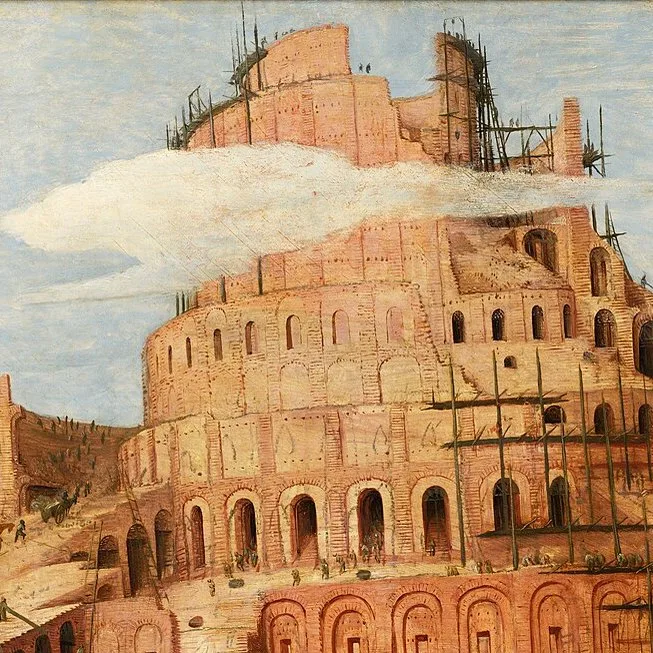
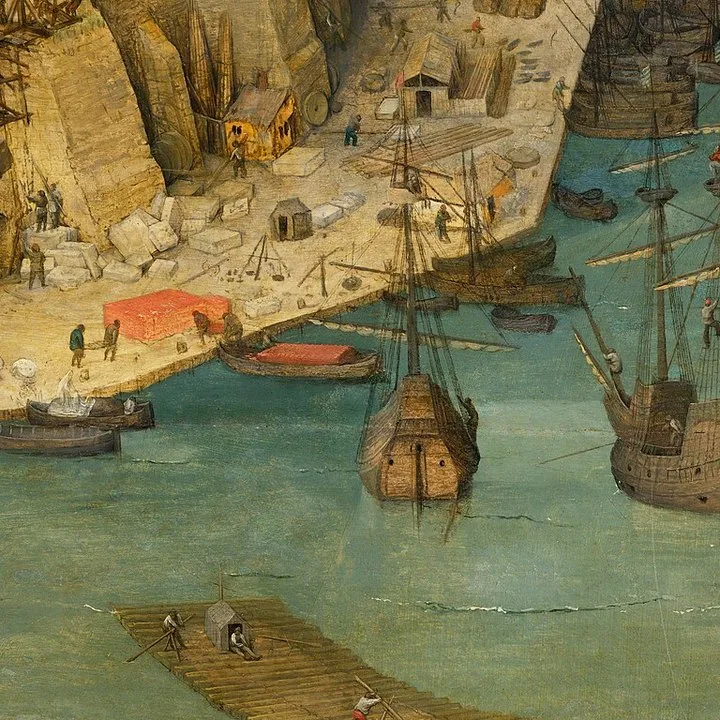
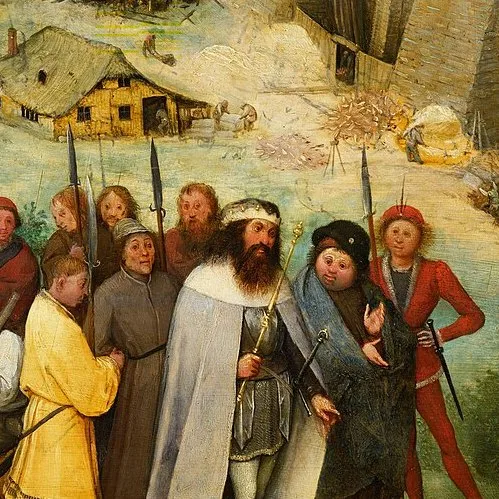
There’s a painting that fascinates me, because it lets you see all of this at once: Bruegel’s The Tower of Babel, the same one on the cover. Bruegel wasn’t thinking about companies, of course. But he painted the tower in the middle of construction, and every part of the method finds a detail there that serves as an example, defect included.11
The Musk method, on one page
Babel: a vast building project that stalls when its builders stop understanding each other.

The problem
Truth gets lost between the one who knows and the one who decides. It goes up softened: the compound lie. It comes down as rules no one can explain: the orphan rule.
In the painting The top, in the clouds, far from the quarry.
The premise
Every company is a factory. Its slowest point sets the pace for everything.
In the painting Ships, cranes and workers: a production line.
The truth going upWhat is happening
Go to the source
The CEO talks to the person doing the work, with no prepared presentations.
In the painting The king comes down to the quarry in person.
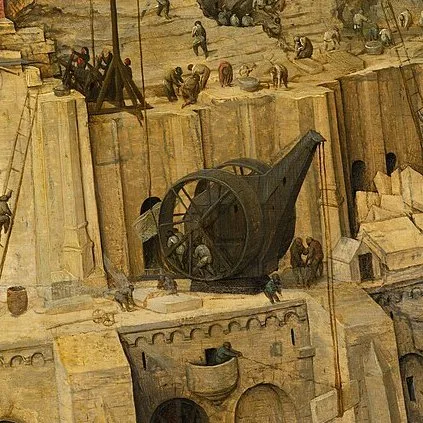
One bottleneck a week
Each week, the CEO goes after the slowest point. Week after week: the compound fix.
In the painting The treadwheel crane: if it’s slow, the whole building is slow.
The truth coming downWhat can be done
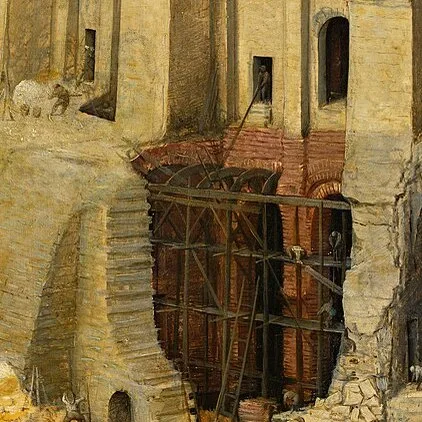
The algorithm
Question, delete, simplify, accelerate and, last, automate. In that order.
In the painting Building on top of half-finished foundations: the order reversed.
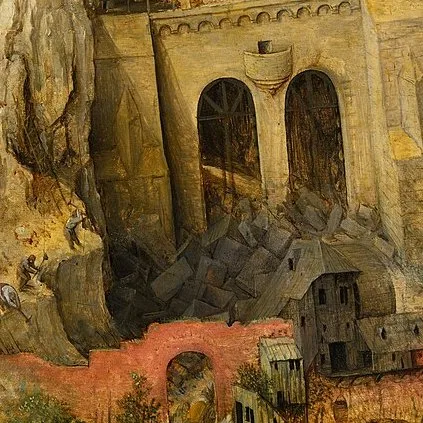
Physics as judge
Only physics can’t be argued with. What a part costs above its raw material, the distance to physics, can.
In the painting Fallen arches: not even the king argues with gravity.
The conditions
A CEO who understands the detail. And a fast judge, one that flags the error in time.
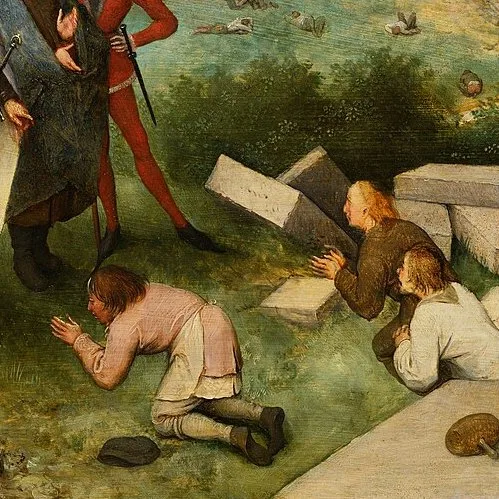
The factory defect
Fear: if the CEO is frightening, the truth arrives glazed again. That is its own cloud.
In the painting The king came down, but everyone kneels before him.
And the AI era? For anyone running a company today, it changes what is worth taking from the method. What serves best is the algorithm, because most companies are making Musk’s 2017 mistake with AI: automating what they already did, without first asking what they should stop doing. What needs adjusting is the method’s ceiling, the CEO’s attention: a machine that reads everything can put the weekly review within reach of someone who isn’t Musk. And you have to watch out for the thirteenth layer: a summary written by a machine trained to please, which spares the CEO the trip to the source and sweetens the bad news.
If I had to keep just three ideas, they would be these.
The first: truth degrades with distance, and that isn’t fixed by asking people to be more honest. It’s fixed by shortening the path. Ford already saw it a century ago, and Musk’s answer is one of structure, not attitude: talk to the person who does the work, skipping a level, and with no prepared presentations.
The second: the CEO’s attention is the scarcest thing a company has, and it yields the most when it’s concentrated. You don’t have to look at everything. You have to find, each week, the slowest point and stay there until it’s fixed. One fix a week doesn’t sound like much. Fifty-two a year change a company.
The third: delete before you automate. Before buying the robot, or the AI, ask what each step is for and who asked for it. The Nevada mats needed a two-million-dollar robot cell, and no one could say what they were for.
And two questions remain open, which are precisely the method’s two conditions. The first is whether it works without Musk. Not even SpaceX knows: in the prospectus it went public with, it warns that losing him could “significantly disrupt” its management structure. The second is whether it works where physics isn’t the judge. In a rocket factory, the error shows up at the next test. In the US government, where Musk tried it in 2025, the error can take years to show. Or it can be as serious as accidentally canceling Ebola prevention, something Musk himself admitted.
Musk may not be copyable. Much of his method is. And it starts with something any CEO can do next Monday: go down to the factory floor.
This is where the blueprint ends. If it’s enough for you, keep it. And if you want to do what Musk does, go down to the factory: every piece is there with its sources, and it starts just below.
Part two
The factory
Each piece of the method, with its sources: what Musk writes and says, and what the people who worked with him recount.
The problem — One in a hundred, one in a hundred thousand
To understand what a method is trying to fix, you first have to see what was broken. And rarely has it been seen as clearly as in 1986.
On January 28 of that year, the space shuttle Challenger broke apart 73 seconds after liftoff, with seven astronauts on board. A presidential commission was formed to investigate the accident, and one of its members was the physicist Richard Feynman. Feynman found that, inside NASA, no one agreed on the probability of losing a shuttle. The estimates ranged from one in a hundred to one in a hundred thousand. “The higher figures come from the working engineers,” he wrote in his report, “and the very low figures from management.”12

One in a hundred against one in a hundred thousand. Between what the one doing the work knew and what the one deciding believed, there was a thousandfold difference. That is the problem the method starts from: the truth gets lost on the way between the one who knows and the one who decides.
How does a gap like that open up? Almost never through one big lie. Marc Andreessen, who did an internship at IBM “at the very height of their power, right before they fell,” describes it precisely. Between him and the CEO there were twelve layers of management, and this is what he saw:
Each layer of management was lying to the one above it, right? And because each layer wants to look good and wants to, whatever, put a little spin on the ball. And if one layer lies to the next layer above it, maybe that’s okay. But when that happens two or three times, the lies compound. […] If that happens 12 times, the CEO has no idea what’s happening.
IBM even had a name for the cloud of men in gray suits who followed the CEO everywhere and kept him from talking to anyone who was actually doing the work: the Big Gray Cloud.13
That mechanism, small lies multiplying, deserves a name, because it’s going to come back again and again.
- ConceptThe compound lie
- What happens to bad news as it climbs a hierarchy. No layer lies much: each one takes a little of its gravity away. But those little cuts multiply, like compound interest.
Let’s do the math. Suppose each layer takes just 10% of the gravity out of the bad news: it passes on 90% of what it received. That doesn’t sound like much. But each cut is made on what was left. The first layer passes on 90%; the second, 90% of that, or 81%; the third, 73%. After twelve layers, 28% reaches the CEO: a little over a quarter of the original gravity.
What’s left of bad news, layer by layer
- CEO28%
- Layer 1131%Layer 11: 31%
- Layer 1035%Layer 10: 35%
- Layer 939%Layer 9: 39%
- Layer 843%Layer 8: 43%
- Layer 748%Layer 7: 48%
- Layer 653%Layer 6: 53%
- Layer 559%Layer 5: 59%
- Layer 466%Layer 4: 66%
- Layer 373%Layer 3: 73%
- Layer 281%Layer 2: 81%
- Layer 190%Layer 1: 90%
- Engineer100%
And it isn’t a NASA problem or an IBM problem. Back in 1922, Henry Ford was already complaining about organization charts shaped like family trees: the message of a man living in a berry on the lower left-hand corner of the chart, he wrote, takes about six weeks to reach the company’s president.14 A hundred years later, the complaint is the same. In 2023, Mark Zuckerberg wrote to Meta’s employees that “every layer of a hierarchy adds latency and risk aversion,” because every manager reviews the work and “polishes off some rough edges” before sending it further up.15
Polishing off rough edges is the polite version of putting spin on the ball.
For a century, those layers were the best solution we had. The historian Alfred Chandler showed that the large modern corporation was born when the “visible hand” of management replaced the invisible hand of the market in coordinating work.16 The problem is that this hand works best when nothing changes. In 1997, Clayton Christensen, a Harvard professor, studied why leading companies fall when a new technology arrives, and IBM was among his examples. His conclusion was uncomfortable: in well-managed firms, “good management was the most powerful reason they failed to stay atop their industries.”17 When something changes, what matters most is what can be seen from below. And that is exactly what is least likely to reach the top.
So much for the truth going up. The other one travels the opposite way. It’s the truth about what’s possible: what can be done, how much it should cost, how long it should take. That one doesn’t go up. It comes down, from above and from the past, turned into rules: requirements, specifications, procedures.
It has its history too. In 1911, Frederick Taylor, the father of scientific management, charged management with gathering “all of the traditional knowledge” that until then had belonged to the workers and reducing it “to rules, laws, and formulae.”18 It was a great invention: what a worker knew became the company’s. But a rule is a decision someone made once, for a reason. Over the years, the rule stays and the reason goes. Almost always, the name of the person who made it goes too.
Musk explains it with an example. A requirement without an owner, he says, could be something “an intern two years ago randomly came up with off the cuff,” an intern who isn’t even at the company anymore. That’s why it isn’t enough for him that a requirement comes from a department: “You can’t ask the department, you have to ask a person.”19
- ConceptThe orphan rule
- A rule that is still obeyed even though no one knows who set it or why. It’s obeyed because it’s written down.
The two truths get lost in opposite ways. The compound lie makes the CEO believe the company is doing better than it is. The orphan rule makes everyone believe that less is possible than really is.
And neither one is fixed with goodwill. Antonio Gracias, one of Musk’s longest-standing investors, describes him as a “ground truth decision maker”: “he wants the facts.”20 But devotion to facts isn’t enough. IBM’s CEO could have been the most skeptical man in the world and still be surrounded by the gray cloud. Distrusting what comes through layer twelve doesn’t tell you what’s happening below, and suspecting every rule doesn’t tell you which one is superfluous. It takes a structure. The Musk method is that structure.
The premise — Every company is a factory
The structure rests on an unusual idea: every company is a factory, even the ones that don’t make anything. We aren’t used to thinking of a bank or a software company that way.
Musk thinks of everything as a production line, and on any line, in any given week, there is a bottleneck: the slowest point, the one that sets the pace for everything else. It doesn’t have to stop the line. It’s enough that it slows it down: a stopped line is just the extreme case.
And Musk takes it literally. Walter Isaacson, his biographer, recounts that at Tesla’s factory in Fremont, California, there is a conference room called Jupiter, which Musk used in 2018 as an office and, at times, as a bedroom. A wall of screens showed in real time what the factory and each of its stations were producing, but Musk watched above all a monitor that colored each station green or red, depending on whether it was flowing properly. The stations had the same lights, so Musk would go out onto the floor and head straight for the problems. His team called it “walk to the red.”21
In 2016 he had told shareholders that the real difficulty lies in “building the machine that makes the machine. In other words, building the factory.” And in 2018 he told his employees that production moves as fast as “the least lucky and least well-executed part” of the entire system.22
The idea is two hundred and fifty years old. In 1776, Adam Smith opened The Wealth of Nations with a pin factory where ten workers, splitting some eighteen operations among them, made upwards of 48,000 pins a day.23 In 1913, Ford made the line move: at his Highland Park plant in Michigan he tried out the first moving assembly line, an idea that, by his own account, came from the Chicago meatpackers, where beef moved along hanging from an overhead rail.24 At postwar Toyota, Taiichi Ohno asked his managers to observe the plant floor “without preconceptions” and to go and see every problem with their own eyes, where it happens.25 And in 1984 the Israeli physicist Eliyahu Goldratt published The Goal, a business novel with a single idea: every plant has a bottleneck, and an hour lost at the bottleneck is an hour lost for the whole system.26
The people who work with Musk know that tradition well. Antonio Gracias, who slept at the factory during the Model 3 launch, had learned Goldratt’s theory years earlier, at a plant of his own. He says he and Musk understood each other because Musk “100% thinks this way.” There is only one question: “What part of my business should I work on today to make the whole system go faster?”27
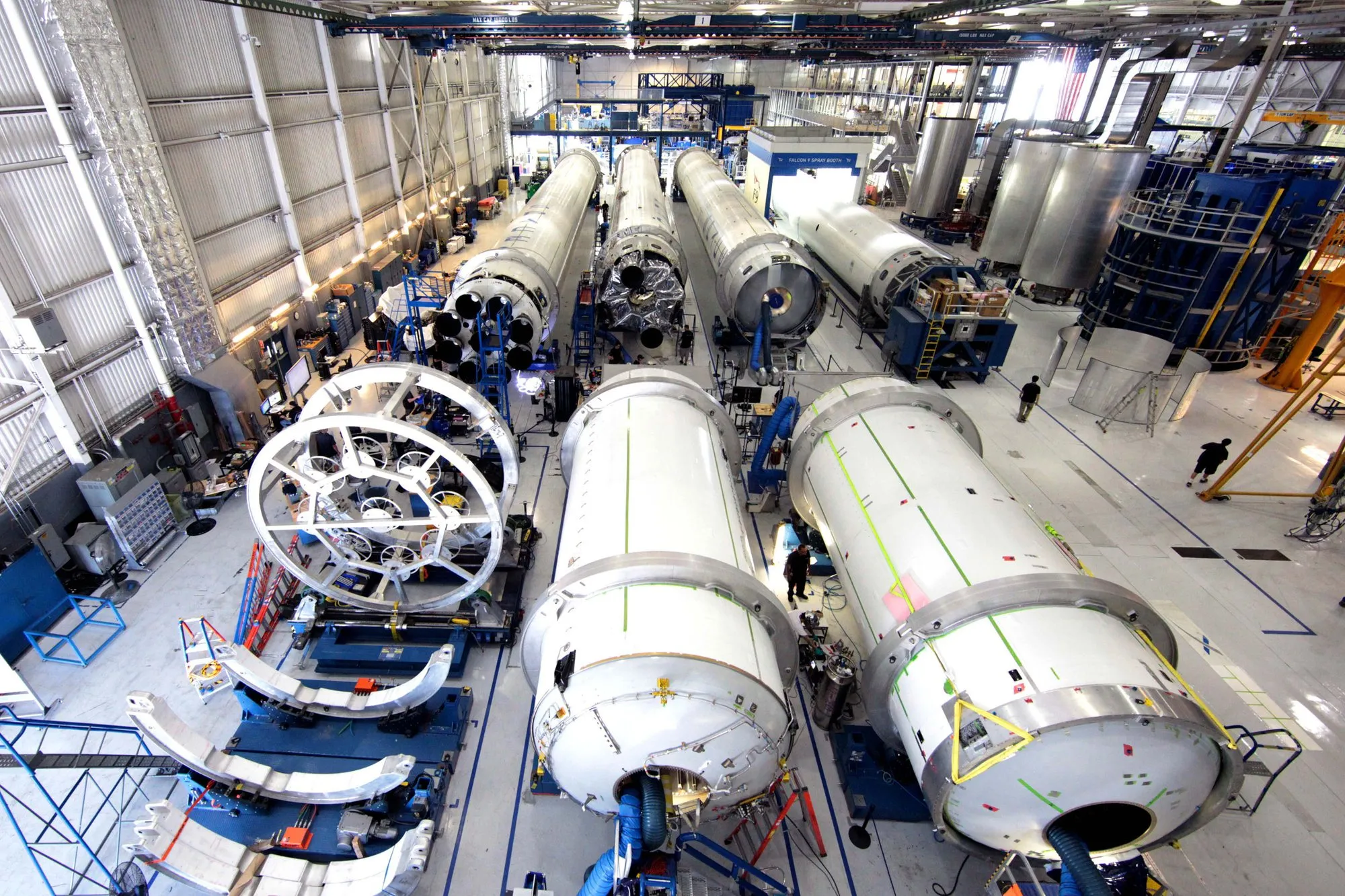
What Musk adds to that tradition is a single thing, and it’s the one that changes everything. At Toyota and in Goldratt’s novel, the one who goes down to look for the bottleneck is the plant manager. At Musk’s companies, the CEO goes down in person, every week. And he goes down with four tools, which are the four pieces of the method.
First piece — Go to the source
If the layers distort the truth, the most direct thing is to skip them and go looking for it where it’s born, which is where the work gets done. It sounds obvious, but it isn’t the norm.
Musk put it in writing in an email to Tesla employees, which the company confirmed when it was published, in 2017:28
- From
- Elon Musk
- To
- All Tesla employees
- Date
- Before August 2017
- Subject
- Communication Within Tesla
There are two schools of thought about how information should flow within companies. By far the most common way is chain of command, which means that you always flow communication through your manager. The problem with this approach is that, while it serves to enhance the power of the manager, it fails to serve the company.
[…] people are forced to talk to their manager who talks to their manager who talks to the manager in the other dept who talks to someone on his team. […] This is incredibly dumb. […]
Anyone at Tesla can and should email/talk to anyone else according to what they think is the fastest way to solve a problem for the benefit of the whole company. You can talk to your manager’s manager without his permission, you can talk directly to a VP in another dept, you can talk to me.
The email is an invitation to everyone. For executives, it’s an obligation: among the rules Musk keeps repeating to them is this one: “Whenever there are problems to solve, don’t just meet with your managers. Do a skip level, where you meet with the level right below your managers.”29
And according to those who were inside, he practices it himself. Karpathy says that a CEO is usually “a remote person five layers up.” Musk would walk into meetings of fifty people and talk directly to the engineers, because for him “engineers and the code are the source of truth […] not some manager.” Karpathy gives an example: if Musk is told that Nvidia will take six months to deliver more chips, he raises an eyebrow and says: “I want to talk to Jensen.”30
In February of this year, Musk explained how he does it today. In his engineering reviews it isn’t his direct reports who speak, but the people who work for them. He goes around the room and each one gives an update. And there can be no advance preparation: “Otherwise you’re going to get ‘glazed,’ as I say these days.” Everything comes coated in sugar.31
Glazing is exactly what every layer at IBM did to bad news. Notice what is special about this piece: it doesn’t ask anyone to be more honest. It changes the path the information takes. The compound lie needs layers to compound. If the CEO talks to the person doing the work, there’s nothing left to compound.
Second piece — One bottleneck a week
Going to the source has a cost: the CEO’s time. No one can talk to every engineer in a company of thousands. The second piece decides whom to talk to, and how often.
Musk explained it in February of this year: “I’m constantly addressing the limiting factor.” He has engineering reviews every week, but his time isn’t spread evenly. If something is going well, there’s no point in his spending time on it. “The irony is if something’s going really well, they don’t see much of me. But if something is going badly, they’ll see a lot of me.”32
He was asked whether that wasn’t micromanagement, and he answered with a joke: “Nano management, please. Pico management.” Then he explained it seriously. Micromanaging is impossible for him: it would take thousands of hours a day. What he does is drill down into the detail only when that detail is the limiting factor for the whole company, because “sometimes the tiny things are decisive in victory.”
Jon McNeill, who was Tesla’s president, calls it the “weekly cadence.” Each week, Musk focuses on “one or two existential issues,” the ones that could kill the company, and meets with those teams. It isn’t the whole company working flat out, McNeill says: these are “special forces, not regular army.”33
Marc Andreessen, whose firm invests in three of Musk’s companies, has told a more extreme version of this routine. In December 2024, on the Modern Wisdom podcast, he summed it up like this: every week, at each of his companies, Musk identifies the biggest problem and fixes it, “52 weeks in a row.” Musk shared the clip with one line: “This is the only way to make rapid progress.”34
In March of this year, on David Senra’s podcast, Andreessen put numbers on it. One day a week at each company, Musk spends twelve or fourteen hours straight in five-minute design reviews, one per engineer: about a hundred and twenty in a day. In each one he asks the same thing: is this the production bottleneck? When he finds the one that is, he stays with that engineer from “eight o’clock till 2:00 AM,” until it’s fixed.35
A hundred and twenty reviews in a day
Those numbers have to be read with care. The five minutes and the hundred and twenty reviews don’t appear in any other source, and Andreessen himself acknowledged he has never sat in on one of those reviews. What Musk endorsed was the general version, the 2024 one. And what he confirms in his own words is the mechanism: reviews every week, and his time put where the company is moving slowest.36
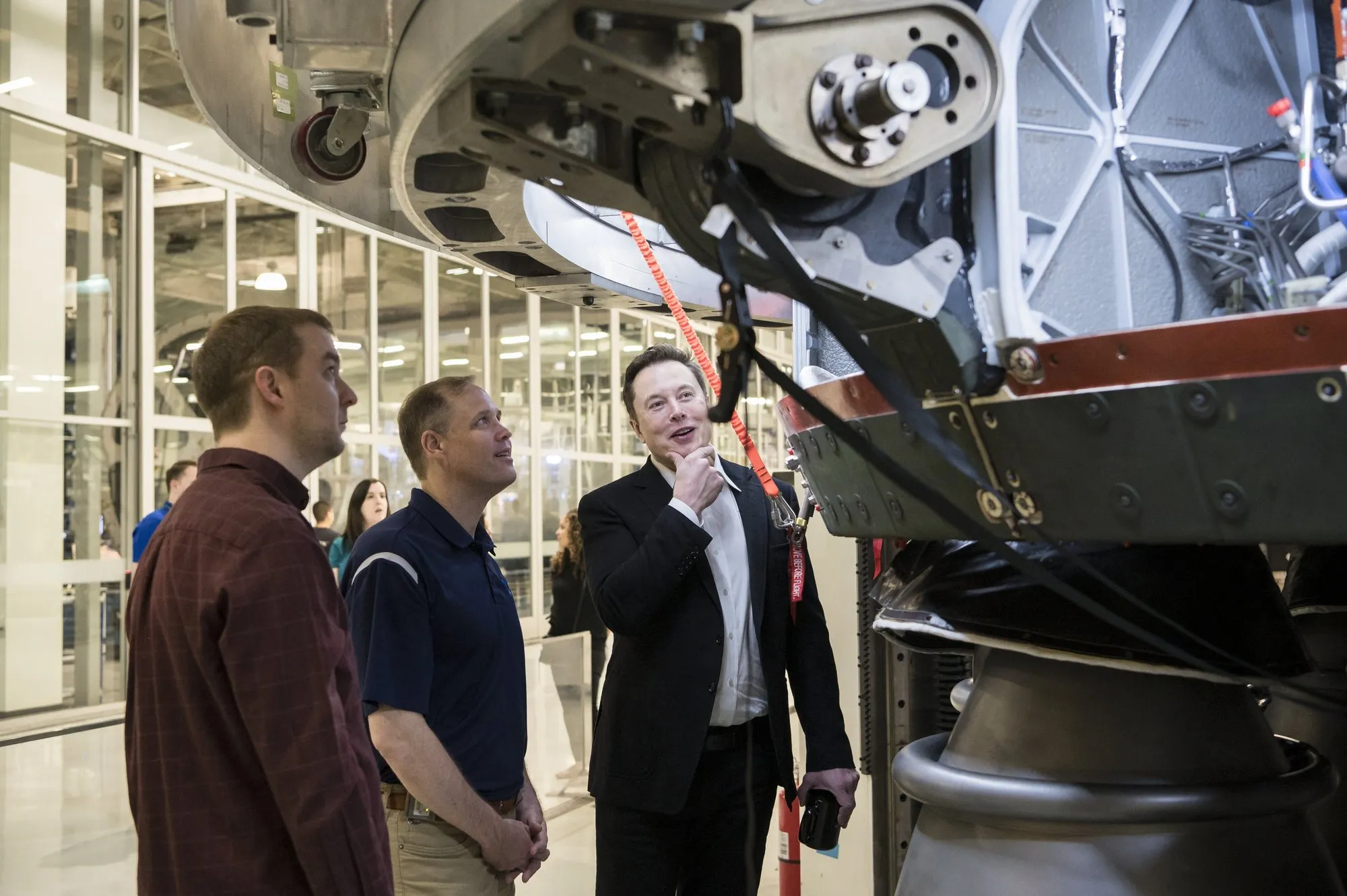
What all this produces isn’t effort. It’s speed. Musk has it among his rules: “A maniacal sense of urgency is our operating principle.”37 That speed resembles what the American pilot John Boyd called maneuver warfare: the winner is whoever operates at a faster tempo than the adversary, whoever gets inside the adversary’s cycle of observing, orienting, deciding and acting.38 Tom Mueller, the engineer who designed SpaceX’s engines, put it with more nuance: the company’s programs were always much slower than Musk wanted, and much faster than anyone had ever gone before.39
There’s a mirror here. IBM’s lies compounded. Musk’s fixes do too.
- ConceptThe compound fix
- The flip side of the compound lie. One bottleneck solved a week, every week, for years. No single fix is huge, but they add up, and they end up changing the speed of the entire company.
Lies pile up on the way up. Fixes pile up over time.
Third piece — The algorithm
The first two pieces aim to correct the truth going up: they say where the problem is. The other two aim to correct the one coming down, the truth of the rules, and they say what to do about it.
The third is a five-step procedure Musk calls the algorithm. Its central idea fits in one line: before you automate something, ask whether it should exist. Musk learned it the worst possible way, by doing exactly the opposite, and it’s worth telling how.
First came the dream. In 2016, Musk imagined the factory of the future as an “alien dreadnought”: a plant so automated that no one would work on the line, because, he said, “otherwise you automatically drop to people speed.”40 With that idea he built the Model 3 factories, for the car that was going to take Tesla to the mass market.
Then came the shock. In July 2017 the first Model 3s rolled out, and Musk greeted the employees with a warning: “Welcome to production hell.” He had promised 5,000 cars a week by the end of the year. In the third quarter they built 260.41
Musk then did what the second piece calls for: he went down to the factory floor to look for the bottleneck. He walked to the red and, at every station, asked the same things: Who’s in charge of this part? Why do we even need this damn sensor? Why are there four bolts here? Can we do it with two? He made decisions on the move: “At least twenty percent are going to be wrong, and we’re going to alter them later. But if I don’t make decisions, we die.”42
Again and again, the answer was the same: the problem wasn’t what was missing, but what was extra. In Nevada it was the fiberglass mats I described in the blueprint. No one could say what they were for, and deleting them saved a two-million-dollar robot cell. Musk drew the conclusion: “I realized that the first error was trying to automate the process,” he told his biographer, Walter Isaacson, “which was my fault because I pushed for a lot of automation.” And he took it all the way. In Nevada it wasn’t enough to switch off the machines they didn’t need: they had to get them out of the plant. “We put a hole in the side of the building just to remove all that equipment,” Musk says.43
The way out was the reverse of the way in: taking machines out, not putting more in. On April 13, 2018, Musk admitted it in public. In an interview with CBS, he showed the couch where he slept at the factory and talked about a “crazy complex network” of conveyor belts: “it was not working, so we got rid of that whole thing.” That same day he wrote on Twitter: “Yes, excessive automation at Tesla was a mistake. To be precise, my mistake. Humans are underrated.”44
Last came a tent. In about two weeks, in the Fremont parking lot, they put up a tent a thousand feet long with a new, almost manual assembly line, like the ones set up to build bombers during World War II. “Not sure we actually need a building,” Musk wrote. “This tent is pretty sweet.” In the last week of June, Tesla built 5,031 Model 3s. One in five came out of the tent.45 The target was met with fewer machines, not more.
And here’s the irony. Until 2010, the Fremont factory had been NUMMI, the plant General Motors shared with Toyota and through which the Toyota Production System entered the United States. Toyota had spent decades teaching what Musk learned the hard way: before you bring in a machine, you have to know how to do the work well by hand. Taiichi Ohno put it bluntly: “The process of automation follows a certain order. […] Automating for the fun of it will only get you in trouble.”46 Musk relearned Toyota’s lesson in Toyota’s old house.
Out of that year came the algorithm, which is that lesson put in order. Musk repeats it so often that, according to Isaacson, his executives move their lips as he recites it, like a congregation following the priest through the liturgy. “I became a broken record on the algorithm,” Musk admits. “But I think it’s helpful to say it to an annoying degree.” It has five steps, and the order matters:47
- Question every requirement. Each one has to come with the name of the person who set it, never the name of a department. Then question it, however smart that person may be: requirements from smart people are the most dangerous, because no one dares to challenge them. Even when they come from Musk himself. And make them less dumb.
- Delete any part or process you can. You may have to add some back. In fact, if you don’t end up putting back at least 10%, you didn’t delete enough.
- Simplify and optimize. But only after step two. The common mistake is to simplify and optimize a part or process that shouldn’t exist.
- Accelerate cycle time. Any process can be made faster, but only after the first three steps. “In the Tesla factory, I mistakenly spent a lot of time accelerating processes that I later realized should have been deleted.”
- Automate. That comes last. “The big mistake in Nevada and at Fremont was that I began by trying to automate every step.”
The order is the exact reverse of the one Musk followed in 2017: “Literally I automated, accelerated, simplified and then deleted.” And he sums it up himself with an image: if you’re digging your own grave, don’t dig faster; stop digging.48
Seen against the blueprint, the algorithm is a machine for cleaning up the truth coming down. The first step finds an owner for every orphan rule. The second deletes the ones no one claims. And the 10% rule works as an alarm: if you never have to put back anything you deleted, you’re still obeying rules you don’t need.
Fourth piece — Physics as judge
The algorithm says to question every requirement. But question it against what? You need a yardstick, and Musk has one among his rules: “The only rules are the ones dictated by the laws of physics. Everything else is a recommendation.”49 Jim Keller, the chip engineer who led the hardware for Tesla’s Autopilot, remembers how Musk put it: first you figure out what configuration you want the atoms in, and then how to put them there.50 Physics first. Then everything else.
At SpaceX it applied from the start. The big aerospace companies followed military and NASA requirements to the letter. Musk did the opposite: every requirement was a recommendation, and you had to know who had set it. Answering “The military” or “The legal department” wasn’t good enough. Over time, the question became a rule: every part, every process and every specification carries a name. Isaacson notes what comes with it: when something goes wrong, Musk knows very quickly whom to blame.51
The sharpest tool in this piece is what Musk calls the “idiot index.” In 2002, back from Russia, where he had been quoted an absurd price for a rocket, he started calculating what its raw materials cost: the carbon fiber, the metal, the fuel. The index is the ratio between the cost of a finished part and the cost of its materials. If a part costs a thousand dollars and the aluminum it’s made of costs a hundred, the design is too complex or the process too inefficient. “If the ratio is high,” Musk says, “you’re an idiot.” Rockets had an extremely high index.52
- ConceptThe distance to physics
- What separates the cost of a part from the cost of the material it’s made of. Physics doesn’t impose that difference: it’s design, process or habit, and so it can be argued with. The idiot index measures it.
Isaacson saw how it’s used. In August 2021, Musk personally took charge of the Raptor, the engine for his Starship spacecraft. Each engine cost two million dollars, and he wanted to bring it down to two hundred thousand. In a meeting, he asked a financial analyst, Lucas Hughes, which were the worst parts according to the idiot index. Hughes didn’t know offhand. Musk forbade him to look at his screen. Hughes named a nozzle part that cost about $13,000. “It’s made of a single piece of steel,” Musk said. “How much does that material cost?” Hughes guessed a few thousand. “No. It’s just steel. It’s about two hundred bucks. You have very badly failed.”
The next day, Hughes came back with a table on a slide. Each part had its columns: which requirements had been questioned, which parts had been deleted and the name of the person in charge. It’s the best image I know of the algorithm turned into a meeting format. They came out with a plan to bring each engine down from two million to two hundred thousand dollars in twelve months.53
SpaceX’s prospectus, the legal document it went public with, spells it out: the company accepts “only the laws of physics” as the limit on its work.54 Three weeks ago, Musk said it his way: “Physics is a harsh judge. […] I’ve seen people break the laws made by humans, but I’ve not seen anyone break the laws made by physics.”55
Feynman had arrived at the same place in 1986. His report on the Challenger ends with a sentence that could hang on the wall of any Musk factory: “For a successful technology, reality must take precedence over public relations, for nature cannot be fooled.”56
That’s why physics holds that place in the method. It’s the only authority with no layers: it doesn’t glaze bad news, and its rules are never orphaned.
First condition — A CEO who understands the detail
The four pieces have something in common: they all run through the CEO’s head. Going to the source works if the CEO understands what the source is saying. Finding the bottleneck takes knowing engineering as much as business. And the idiot index has to be known by heart, as Hughes learned the hard way.
That is the first condition, and Musk made it a rule: every technical manager must have hands-on experience. Software managers, for example, must spend at least 20% of their time coding. Otherwise they are “like a cavalry leader who can’t ride a horse.”57
Jensen Huang, the founder of Nvidia, says it with admiration. Musk has “a great advantage,” because in his head all the systems of a project like his supercomputer work together, and their interdependencies reside “in one head including the financing.”58 Right there lies the objection. Brian Chesky, who holds up Musk as an example of his own way of running a company, warns that “maybe Elon is a bit of a red herring,” because of all his idiosyncrasies.59 And Karpathy, who worked with him for five years, believes copying him is “up to the DNA of the founder.”60 The question, then, is which part of all this can be transplanted into an ordinary CEO.
The objection is older than Musk. Taylor opened his 1911 book with a sentence that sums up the century that followed: “In the past the man has been first; in the future the system must be first.”61 Modern management was born for exactly that: so that a company wouldn’t depend on a genius. The Musk method turns the sentence around. In it, the system is a man again.
Isaacson reached a similar conclusion: “I just don’t think anybody should try to emulate Musk’s time management style.” And SpaceX itself said so in its prospectus: the loss of Musk “could significantly disrupt our management structure,” and the company carries no key-person life insurance on him.62
But some pieces are already being transplanted. Antonio Gracias’s fund has turned production management into a product: an operations team that goes into the companies it invests in to find their bottlenecks.63 Hughes’s table doesn’t need Musk to exist. And there is at least one practice per piece that anyone can copy tomorrow: talk to the person doing the work, skipping a level; give the week’s attention to the limiting factor, not to everything at once; delete before automating; and, faced with any expensive part, ask what its material costs.
What doesn’t transplant is the condition: a CEO able to sit down as an equal with the engineer at two in the morning.
Second condition — A fast judge
The second condition is hidden in the algorithm, in the 10% rule. Deleting without fear makes sense if you find out quickly that you got it wrong. In a rocket factory, you find out quickly: if you deleted a part you needed, the rocket fails at the next test, and you put it back. Losing a rocket is anything but cheap, of course. But it’s far less serious than discovering the mistake years later, or with people on board. Musk uses the space shuttle precisely as the counterexample: since it always flew with a crew, there was almost no room to iterate, and many known problems went uncorrected because people were “too afraid to make change.”64 Physics is a harsh judge, but a fast one.
- ConceptThe fast judge
- The reality that tells you early that you got it wrong, while you can still correct course. It’s what lets you delete without fear: if you went too far, you find out at the next test and put back what was missing.
Outside the factory, Musk has tried the method twice.
In October 2022 he bought Twitter and applied the premise to a company that doesn’t make anything. “At its heart, Twitter is a software and servers company,” he wrote to employees in November, as he told them that from then on they would need to be “extremely hardcore.”65 By April 2023, about 1,500 remained of the nearly 8,000 there had been when he bought it. “The pain level of Twitter has been extremely high,” he acknowledged. “Were there many mistakes made along the way? Of course.”66 And the case set an example: that year, Meta removed layers of managers under the motto of Zuckerberg’s letter, “Flatter is faster.”
In 2025 it was the US government’s turn, with Musk at the head of the Department of Government Efficiency, DOGE. Antonio Gracias, who went with him, summed it up: “Twitter was the warm up.”67 Musk arrived with the weekly review under his arm. On February 22, 2025, Musk announced that all federal employees were going to receive an email asking them to say what they had done the previous week, and that failing to respond would be taken as a resignation. The email was sent by the government’s personnel office:68
- From
- Human Resources, Office of Personnel Management (OPM)
- To
- All federal employees
- Date
- February 22, 2025
- Subject
- What did you do last week?
Please reply to this email with approx. 5 bullets of what you accomplished last week and cc your manager.
Please do not send any classified information, links, or attachments.
Deadline is this Monday at 11:59pmEST.
It was the weekly review, now applied to the entire federal government. And with it came the other half of the algorithm: delete fast and, if necessary, put back. At Trump’s first cabinet meeting, Musk himself explained it with an example. “We also will make mistakes,” he said, but “when we make a mistake, we’ll fix it very quickly.” Among the things DOGE had accidentally canceled, he said, was Ebola prevention, which according to him was restored immediately: “there was no interruption.”69
And did it work? Musk had talked about saving “at least $2 trillion,” and the savings never showed up: federal spending in fiscal year 2025 ended up 4% higher than the year before. Not all of that can be pinned on DOGE, because most of that spending is mandatory by law.70 But it was missing something the factory has in abundance: a fast judge, to warn it early if it had deleted too much. In a rocket factory, that warning is the test. In government, the only thing that arrives quickly after a cut is complaints.
And complaints are a bad judge, as Musk himself ended up discovering. In February of this year he said it is “extremely difficult” to cut even the most obvious waste and fraud, because the government “has to operate on who’s complaining.” And the people who complain include those who are right, but also those who aren’t. If you cut off payments to fraudsters, they immediately come up with the most moving reason possible to keep getting paid. They don’t say, “Please keep the fraud going.” They say, “You’re killing baby pandas.” According to Musk, no baby pandas were dying: the stories were false, but they still stirred sympathy. “That’s what happened,” he concluded. “Perhaps I should have known better.”71
That’s the problem. If a complaint sounds just as heartbreaking when you’ve cut fraud as when you’ve cut something necessary, it doesn’t tell you whether you got it wrong. What would tell you, the real damage, arrives late: deleting Ebola prevention might only be noticed when there’s an outbreak. In government, what’s fast doesn’t judge, and what judges isn’t fast.
Almost a century ago, the English writer G. K. Chesterton proposed a rule for cases like these: if you find a fence across a road and don’t know why it’s there, don’t take it down. “Go away and think. Then, when you can come back and tell me that you do see the use of it, I may allow you to destroy it.”72 The algorithm says the opposite: take it down and, if it was needed, put it back. That works when the judge is fast and there’s still time to put it back. And almost only then.
The factory defect — Its own cloud
So far, the method looks like a machine for getting to the truth. But it comes with a factory defect, and it was described by the very people who worked with him.
Tom Mueller recalls that, in SpaceX’s early years, if you were negative or thought something couldn’t be done, “you were not invited to the next meeting.” Isaacson puts it precisely: it was a good way to push people to do what they thought was impossible, “but it was also a good way to become surrounded by people afraid to give you bad news.”73
There’s one small detail that sums it all up. In 2017, the woman in charge of safety on Fremont’s assembly line asked to mark the pedestrian walkways in yellow. Her supervisor replied: “Elon does not like the color yellow.”74 Six years later, Reuters found the same thing at SpaceX: supervisors having machines painted in safety yellow repainted black or blue, because Musk doesn’t like bright colors. That investigation documented more than 600 workplace injuries the company had not reported. In 2022, the Brownsville plant in Texas had an injury rate six times higher than the space industry average.75
Information makes two very different journeys. Bad news climbs with difficulty, if it climbs at all. The CEO’s taste comes down intact, through every layer, all the way to the color of a strip of tape on the floor.
Bad news goes up diminished. The CEO’s tastes come down intact.
Where does that fear come from? In part, from one of the method’s own pieces. Remember Lucas Hughes, the analyst who didn’t know by heart the engine’s worst parts according to the idiot index? Isaacson was in that meeting, and he tells a part I left out before. In a monotone, without showing any emotion, Musk warned him: “If you ever come into a meeting and do not know what are the idiot parts, then your resignation will be accepted immediately.” The next day, Hughes came back with the table. When Isaacson asked Musk whether he had been too harsh, Musk answered with a principle: “I give people hardcore feedback, mostly accurate, and I try not to do it in a way that’s ad hominem. […] Physics does not care about hurt feelings. It cares about whether you got the rocket right.”76
It’s physics as judge, applied to people. With Hughes, it worked. But whoever walks out of a meeting like that, and whoever watched it, doesn’t learn only the idiot index. They also learn that showing up without the answer, or with one the CEO doesn’t want to hear, can cost them their job. A rocket doesn’t learn to hide its flaws. A person does.
In fairness, Musk asks for the opposite of fear. “There’s plenty of forgiveness if you pass me the buck. There is no forgiveness if you don’t,” he told the journalist Eric Berger in 2020.77 And in 2021 he wrote to Tesla’s managers that, faced with an order from him, the first possible response was to explain why he was wrong: “Sometimes, I’m just plain wrong!” If they did none of what the email asked, they would be asked to resign.78
The two things coexist, and his emails show it better than anything. This one, from 2010, goes after a very specific form of bureaucracy:79
- From
- Elon Musk
- To
- All SpaceX employees
- Date
- May 2010
- Subject
- Acronyms Seriously Suck
There is a creeping tendency to use made up acronyms at SpaceX. […] No one can actually remember all these acronyms and people don’t want to seem dumb in a meeting, so they just sit there in ignorance.
That needs to stop immediately or I will take drastic action […]. Unless an acronym is approved by me, it should not enter the SpaceX glossary.
[…] VTS-3 is four syllables compared with “Tripod,” which is two, so the bloody acronym version actually takes longer to say than the name!
Read the middle paragraph again. The rule against bureaucracy requires the CEO’s personal approval. The method that skips the layers to reach the truth can create its own cloud.
- ConceptIts own cloud
- The one the method forms when the CEO inspires fear. Bad news goes up diminished again: no longer because of the layers, but because of fear.
The defect comes from the same place as the strength. A method that runs entirely through one CEO’s head also depends on what that CEO wants to hear.
The AI era — The machine that reads for you
I began this essay with an idea: to take apart the way Musk manages, see what makes it different and open it up so it can be of use to someone whose name isn’t Elon Musk. But that someone won’t apply it in the Fremont of 2018. They’ll apply it in the middle of the AI era, and there’s no going back from that. Their company may be post-AI, as they say in the startup world: born after AI and built around it. Or it may have been born before and be trying to become one. Either way, the last question is the most practical: if you run a company today, what in the method is useful to you, what do you have to adjust and what do you have to watch out for?
The question matters, because AI touches several pieces of the method. After all, much of the method is about how truth travels inside a company, and AI is, among other things, a machine for moving information. Sometimes it works in your favor. Sometimes, against you. What follows are the points I think are important to consider. They don’t claim to be definitive: they’re the ones I would look at first.
What I think serves best today is the algorithm, and above all its order. Many companies are adopting AI by way of the fifth step: they automate what they already did, without first asking whether they should keep doing it. The results look like the Model 3’s before the tent. According to a 2025 MIT report, 95% of organizations were getting zero return on what they had invested in generative AI. And the diagnosis sounds like Fremont in 2018: the tools accelerated work, “but did not change team structures or budgets.” And in February of this year, nine in ten executives at nearly six thousand firms in four countries said AI had not changed their company’s productivity or employment over the past three years.80
It isn’t the first time. When electricity arrived, factories took decades to gain productivity, because at first they swapped the steam engine for an electric motor and left everything else the same. The gains came in the 1920s, when factories were redesigned around the new motor.81 The same is happening with AI: a company doesn’t become post-AI by plugging AI into what it already did, but by redesigning itself around it. Deleting before automating isn’t a Musk quirk. It’s what electricity already taught, a century ago.
And it seems to me that the first step, questioning, is going to be worth even more. Paul Graham said a month ago that the best predictor of a startup’s success is still how fast it ships new things, and that AI hasn’t changed that: many are still slow, even with the best tools. First, he said, you have to think of the ideas.82 If producing becomes almost free, the bottleneck moves to where Musk always looked: deciding what shouldn’t exist.
What I would adjust is the ceiling. The method had one, and it was the CEO’s attention: a hundred and twenty reviews in a day is the limit of a human being, and perhaps of a single one. That’s where AI really can change things. A machine able to read everything that happens in a company could show any CEO where the week’s red is, and put the weekly review within reach of someone who isn’t Musk.
Some go further: for them, a post-AI company no longer needs the layers. Chandler’s hierarchy was, at bottom, a machine for moving information, and now there are machines that move it better. In March of this year, Jack Dorsey, a cofounder of Twitter and now CEO of the payments company Block, put it bluntly in an essay: “There is no need for a permanent middle management layer. Everything else the old hierarchy did, the system coordinates.” A month earlier, Block had cut its staff nearly in half.83
The adjustment I propose, then, is to use the machine to know where to go, not to save yourself the trip.
And there are at least two things I would watch out for. The first comes in through the first piece. Remember why Musk forbids preparing for reviews? So he doesn’t get glazed. In April 2025, the same word was used to describe ChatGPT. After an update, the model started agreeing with everyone and cheering any idea, and Sam Altman, the CEO of OpenAI, admitted it in one line: “yeah it glazes too much.” OpenAI’s explanation was that the model had learned too much from users’ immediate approval.84 It’s the same incentive as every layer at IBM: bring good news to look good. A CEO who trades the trip to the source for a summary written by a machine like that isn’t taking layers out of the company. They’re adding one.
- ConceptThe thirteenth layer
- A summary of what’s happening in the company written by a machine trained to please. It spares the CEO the trip to the source, and for that very reason it can become the thirteenth layer of the gray cloud.
The second is the judge, and Musk’s own AI shows it. His supercomputer in Memphis was built in 122 days. “We were told it would take 24 months to build,” the company’s page says. “So we took the project into our own hands, questioned everything, removed whatever was unnecessary, and accomplished our goal in four months.” But xAI, by Musk’s own account, “was not built right first time around” and “is being rebuilt from the foundations up.” Macrohard, his project to create “a purely AI software company,” stalled. And this year, most of the growth in his AI business came from renting out computing capacity to other companies, among them Anthropic, which pays $1.25 billion a month.85 With atoms, deadlines and warehouses, the judge is fast and the algorithm is unbeatable. With organizations and software, the judge is slow.
And redesigning a company around AI means deleting precisely there, in the organization, where the judge is slow to rule. Block’s own essay admits it: parts of its transition “will likely break before they work.” If your judge is slow, one way out is to build a fast one: test with one team before deleting across the whole company, so the error shows up early, while you can still put back what was missing.
If I’m right, the AI era doesn’t retire Musk’s method. It makes it cheaper to copy, and easier to betray.
For those of us who aren’t Musk
You don’t have to be Musk to use the best of his method. It comes down to a few principles, and none of them requires his temperament.
Truth degrades with distance. And that isn’t fixed by asking people to be more honest, but by shortening the path: talk to the person doing the work, skipping a level, and with no prepared presentations. Today, that includes not letting a machine prepare them for you.
The CEO’s attention is the scarcest thing a company has. And it yields the most when concentrated: one bottleneck a week, until it’s fixed. A machine can help you find it. Fixing it is still your job.
Order matters. Question, delete, simplify, accelerate and, only at the end, automate. This decade holds more temptation than any other, because it has never been so easy to automate something that shouldn’t exist.
But no blueprint tells you whether the ground can bear the building. Before you start, it’s worth asking yourself two questions, which are precisely the method’s two conditions. No one can answer them for you.
Can you operate it? The method calls for a CEO who understands the detail, able to sit down as an equal with the engineer. A machine can read for you, but it can’t understand for you. And it also calls for a CEO who doesn’t frighten people, because the one who does ends up building their own cloud. Not even SpaceX knows whether the method works without Musk: it warns as much in its prospectus. A method that depends on a temperament isn’t yet a method.
Is your judge fast? In a rocket factory, the error shows up at the next test. In a social network, in a government or in a team of frightened people, it can take years to surface, and by then no one dares to say so. Before you delete on a large scale, ask yourself how long it will take you to find out whether you got it wrong.
The book wheel
In 1588, Agostino Ramelli, an Italian military engineer in the service of the king of France, published a book with 195 machines: water pumps, mills, cranes. One of them is a book wheel. The reader sits in front of a tall wheel, turns it and, thanks to gears that keep the lecterns level, dozens of open books pass before him. Ramelli recommended it for scholars, “especially those who are indisposed and tormented by gout”: it let them read everything without getting up from their chair.86
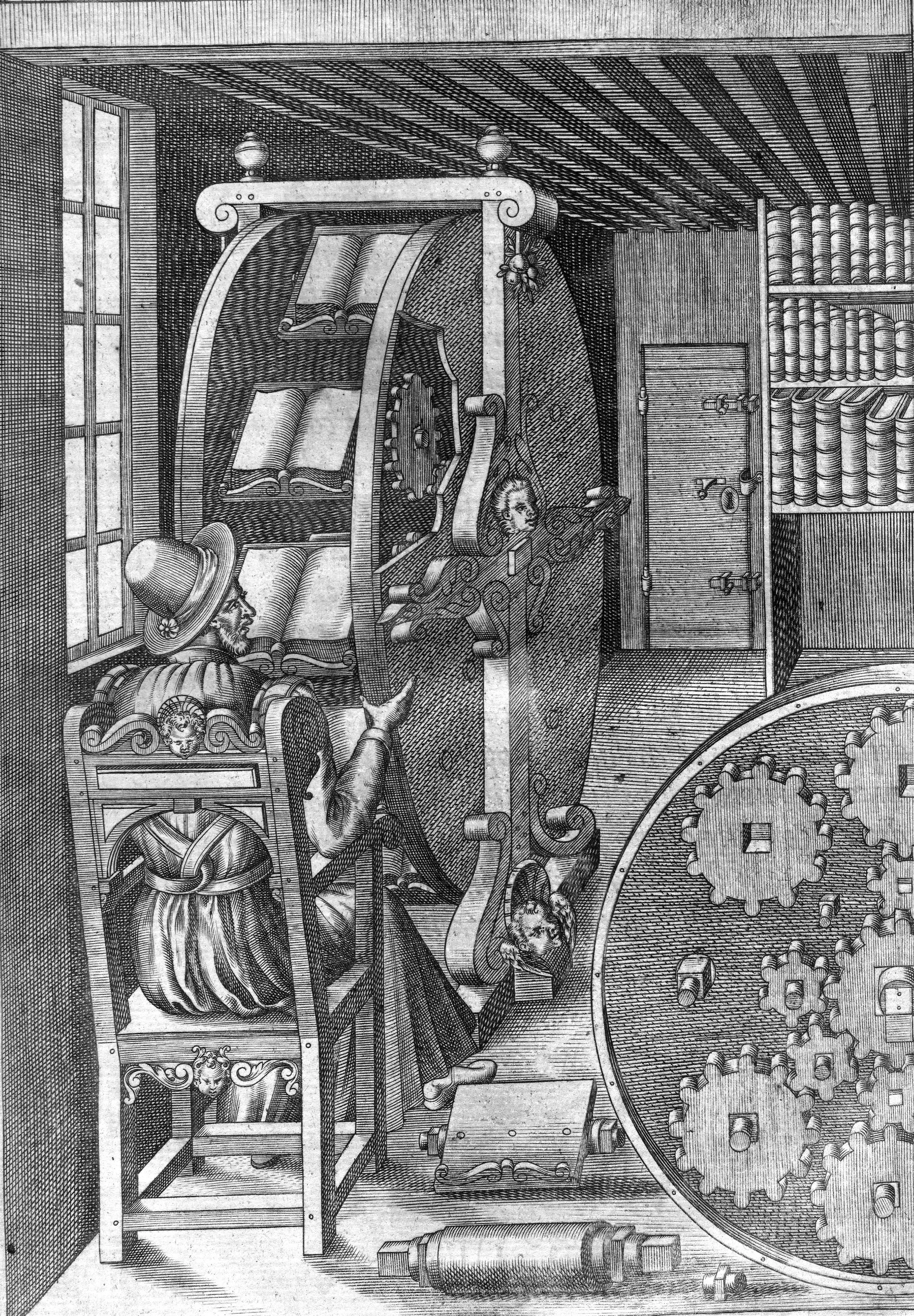
AI is that wheel, only gigantic. It promises that a CEO can know everything happening in the company without getting up from the chair, and part of that promise is real. Ramelli brought a few dozen books within the reader’s reach. An AI can bring a CEO everything written in the company: every report, every ticket, every number, every complaint. Not even Musk, with his hundred and twenty reviews in a day, reads that much. A machine like that can show you where the week’s red is, and raise the method’s ceiling so that someone who isn’t Musk can use it.
But Ramelli’s wheel worked for a reason that’s easy to overlook: its books were already written. What the method looks for, often, isn’t. The bad news that twelve layers softened reaches the machine already softened. What the engineer doesn’t dare say isn’t in any document. And the orphan rule is written down, but its reason was lost years ago. A machine that reads everything can hand you back, in impeccable prose, the friendly version of a disaster. And if it was also trained to please you, it will serve it to you glazed.
Can it be fixed? In part, I think so. You can ask the machine for the red and not the summary, for the bad news before the good, for the cost of each part next to the cost of its raw material. You can ask it to tell you where to go, not to tell you what you would find if you went. What can’t be fixed is the rest. Much of the truth the method pursues isn’t written down anywhere. It’s on the factory floor, at the station that’s running slow, on the face of the person doing the work when you ask how it’s going. To see it, you have to do what Musk does: get up, cross the plant walking to the red and sit with the engineer until two in the morning.
In the end, the AI era changes the tools, but not the challenge. It’s the same one Ford had in 1922, when a message from someone at the bottom of the organization chart took six weeks to reach the president. It’s the same one Musk faces every week, walking to the red. And it will still be the same in a post-AI company, even if the reports arrive in a second and perfectly written: how the truth gets from the one who knows to the one who decides.
The wheel turns faster than ever. The truth is still down below.
References
-
Lex Fridman, interview with Mark Zuckerberg (episode 383), June 8, 2023, around 1:43:48.
-
Andrej Karpathy, conversation with Stephanie Zhan at Sequoia AI Ascent, March 26, 2024, around 0:16:15.
-
Nilay Patel, interview with Brian Chesky, Decoder (The Verge), October 28, 2024. In the same interview he keeps his distance: “Maybe Elon is a bit of a red herring,” he says, because of all his idiosyncrasies.
-
David Senra, interview with Marc Andreessen, “The World Is More Malleable Than You Think,” March 15, 2026: the school of management comes around 1:21:41; Senra returns to the subject around 1:31:47; the closing line, around 1:48:59. Official transcript.
-
Paul Graham, “Founder Mode”, September 2024. The essay grew out of a talk Brian Chesky gave at a Y Combinator event. The acknowledgments read: “Thanks to Brian Chesky, Patrick Collison, Ron Conway, Jessica Livingston, Elon Musk, Ryan Petersen, Harj Taggar, and Garry Tan for reading drafts of this.” On meetings: “‘Skip-level’ meetings will become the norm instead of a practice so unusual that there’s a name for it.” Musk’s skip-level rule is in Walter Isaacson, Elon Musk (Simon & Schuster, 2023), ch. 46, pp. 284–286.
-
Jon McNeill, The Algorithm: The Hypergrowth Formula That Transformed Tesla, Lululemon, General Motors, and SpaceX (Portfolio, 2026), published on March 24. According to the publisher, it is the first book written by someone who reported directly to Musk. I haven’t read it: what I quote from McNeill comes from his talks.
-
SpaceX, initial public offering prospectus (Form 424B4), June 11, 2026, section “Our Repeatable Business Model.” The algorithm is the fourth of seven principles; the text reads: “We apply the Algorithm across every aspect of our organization.” It is cited again in the fourth piece.
-
Henry Ford and Samuel Crowther, My Life and Work (New York, Doubleday, 1922), ch. VI, “Machines and Men.” The full passage: “It takes about six weeks for the message of a man living in a berry on the lower left-hand corner of the chart to reach the president or chairman of the board, and if it ever does reach one of these august officials, it has by that time gathered to itself about a pound of criticisms, suggestions, and comments.” The berries belong to the tree Ford describes a paragraph earlier: “The tree is heavy with nice round berries, each of which bears the name of a man or of an office.”
-
Musk tells the story in the Starbase tour with Tim Dodd (Everyday Astronaut), part 1, August 2021, around 23:29, and at the Baron Capital conference of November 4, 2022. The robot that dropped the mats and the sound test are in Walter Isaacson, Elon Musk (Simon & Schuster, 2023), p. 272: “See if you can tell the difference,” he told them. “They couldn’t.” The anecdote comes back in the third piece.
-
Musk with Tim Dodd (Everyday Astronaut), Starbase tour, part 1, August 2021, around 22:02: “I have personally made the mistake of going backwards on all five steps multiple times… on Model 3. Where literally I automated, accelerated, simplified and then deleted.” The Model 3 promise and figures are from the delivery event of July 28, 2017, and from Tesla’s letters to shareholders of August 2 and October 2, 2017.
-
Pieter Bruegel the Elder, The Tower of Babel, 1563, oil on panel, Kunsthistorisches Museum, Vienna. That King Nimrod appears with his retinue at the lower left, and that the painting shows the cranes, the scaffolding over the unfinished brick foundations and the harbor that supplies the works, is explained in the museum’s presentation. The reading of the method in the painting is mine.
-
Richard P. Feynman, “Personal Observations on Reliability of Shuttle”, appendix F to the report of the Presidential Commission on the Challenger accident, 1986: “The estimates range from roughly 1 in 100 to 1 in 100,000. The higher figures come from the working engineers, and the very low figures from management.”
-
David Senra, interview with Marc Andreessen, cited, between 1:32:18 and 1:37:07.
-
Henry Ford and Samuel Crowther, My Life and Work (New York, Doubleday, 1922), ch. VI, “Machines and Men.”
-
Mark Zuckerberg, “Update on Meta’s Year of Efficiency”, March 14, 2023.
-
Alfred D. Chandler Jr., The Visible Hand: The Managerial Revolution in American Business (Harvard University Press, 1977), pp. 1 and 7.
-
Clayton M. Christensen, The Innovator’s Dilemma (Harvard Business School Press, 1997), introduction: “in the cases of well-managed firms such as those cited above, good management was the most powerful reason they failed to stay atop their industries.” IBM is among the companies cited.
-
Frederick W. Taylor, The Principles of Scientific Management (New York, Harper & Brothers, 1911), ch. II.
-
Musk with Tim Dodd (Everyday Astronaut), Starbase tour, part 1, August 2021, around 16:00.
-
Antonio Gracias on Invest Like the Best, episode 271, April 5, 2022.
-
Walter Isaacson, Elon Musk (Simon & Schuster, 2023), ch. 46, “Fremont Factory Hell,” p. 278. Isaacson’s monitor shows each station “with a green or red light indicating whether it was flowing properly,” and the team called it “walk to the red.”
-
Tesla annual shareholder meeting, May 31, 2016. Email “Progress, Precision and Profit,” April 17, 2018, published in full by Electrek.
-
Adam Smith, An Inquiry into the Nature and Causes of the Wealth of Nations (1776), book I, ch. 1: the trade of making a pin is divided into “about eighteen distinct operations,” and ten workers “could make among them upwards of forty-eight thousand pins in a day.”
-
Henry Ford and Samuel Crowther, My Life and Work (New York, Doubleday, 1922), ch. V, “Getting Into Production”: “Along about April 1, 1913, we first tried the experiment of an assembly line. […] I believe that this was the first moving line ever installed. The idea came in a general way from the overhead trolley that the Chicago packers use in dressing beef.”
-
Toyota, “Toyota Traditions”, March–April 2006, which quotes Ohno: “Observe the production floor without preconceptions.” On genchi genbutsu: “going to the source, and clarifying the problem with one’s own eyes.”
-
Eliyahu M. Goldratt and Jeff Cox, The Goal (Great Barrington, North River Press, 1984). The line about the lost hour is one of the most quoted in the book.
-
Antonio Gracias on Invest Like the Best, episode 271, April 5, 2022; on the Model 3, at the Upfront Summit, February 26, 2026.
-
Justin Bariso, “This Email From Elon Musk to Tesla Employees Describes What Great Communication Looks Like”, Inc., August 30, 2017. According to Inc., Musk sent the email “a few years ago,” and Tesla confirmed it went to all employees; the exact date is unknown.
-
Isaacson, Elon Musk, ch. 46, pp. 284–286. Isaacson writes that the algorithm was sometimes accompanied by a few corollaries. This essay quotes four: skipping a level, the maniacal urgency, physics as the only rule and managers’ hands-on experience.
-
Andrej Karpathy at Sequoia AI Ascent, March 26, 2024, between 0:16:39 and 0:19:20.
-
Dwarkesh Patel and John Collison, interview with Elon Musk, February 5, 2026, around 2:14:30–2:15:30. Glazing is the internet’s word for cloying flattery.
-
Dwarkesh Patel and John Collison, interview cited, around 2:12:04, 2:14:30 and 2:17:27; the exchange on micromanagement is in the same stretch of the official transcript.
-
Jon McNeill at the New Orleans Book Festival, March 24, 2026, around 0:39:36, at the launch of his book. McNeill left Tesla in February 2018: what he says about the years after that, he didn’t see in person.
-
Marc Andreessen with Chris Williamson, Modern Wisdom, episode 877, December 14, 2024, around 0:22:48: “he shows up every week at each of his companies, he identifies the biggest problem that the company’s having that week and he fixes it, and then he does that every week for 52 weeks in a row.” Musk shared it on X on December 20, 2024: “This is the only way to make rapid progress.”
-
Senra, around 1:31:47 and 1:40:39: “I have not actually sat in on these.” On his firm’s investments in X, xAI and SpaceX, Modern Wisdom, episode 877, December 14, 2024. The mechanism: the Dwarkesh Patel and John Collison interview cited in the first piece.
-
Isaacson, Elon Musk, ch. 18, pp. 113–114, and ch. 46, pp. 284–286. In the interview with Dwarkesh Patel and John Collison (2026), Musk repeats it in his own words: the urgency “is going to come from whoever is leading the company.”
-
John Boyd, Patterns of Conflict (1986), slide 5. Andreessen makes the comparison too, in Senra, around 1:41:24.
-
Model 3 delivery event, July 28, 2017. Tesla, letters to shareholders of August 2 and October 2, 2017, on EDGAR.
-
Musk with Tim Dodd (Everyday Astronaut), Starbase tour, part 1, August 2021, around 23:29; the same anecdote, with Dilbert, at the Baron Capital conference of November 4, 2022. Isaacson, Elon Musk, pp. 272–274; the hole is on p. 274: “We put a hole in the side of the building just to remove all that equipment.”
-
CBS This Morning, interview by Gayle King, April 13, 2018. Musk on X, April 13, 2018.
-
Isaacson, Elon Musk, pp. 282–283. Musk on X, June 2018. Tesla, letter of July 2, 2018: the tent line, GA4, “was responsible for roughly 20% of Model 3s produced last week.”
-
Toyota, “Toyota Production System”. Taiichi Ohno, Workplace Management (1982; Productivity Press, 1988), p. 100.
-
Isaacson, Elon Musk, ch. 46, pp. 284–286. Musk explains it with the same five steps in the Starbase tour (2021), at the Baron Capital conference (2022) and in the interview with Lex Fridman (episode 438, 2024).
-
Jim Keller with Lex Fridman, episode 70, February 5, 2020, around 1:04:40: “Elon said, first you figure out what configuration you want the atoms in and then how to put them there.”
-
Isaacson, Elon Musk, ch. 59, “Starship Surge,” pp. 362–367. An excerpt was published with the publisher’s permission on Space.com.
-
SpaceX, initial public offering prospectus (Form 424B4), June 11, 2026, section “Our Engineering-First Culture”: “we accept only the laws of physics as the limiting factors to our work and mission.”
-
Feynman, appendix F, cited: “For a successful technology, reality must take precedence over public relations, for nature cannot be fooled.”
-
Jensen Huang on BG2, with Bill Gurley and Brad Gerstner, September 25, 2025, around 0:58.
-
Nilay Patel, interview with Brian Chesky, Decoder, cited: “Maybe Elon is a bit of a red herring because there’s all the surface-level things about him that are idiosyncratic.”
-
Andrej Karpathy at Sequoia AI Ascent, cited, around 0:22:40: “I think it’s up to the DNA of the founder.”
-
Taylor, The Principles of Scientific Management, introduction. The sentence goes on: “This in no sense, however, implies that great men are not needed.”
-
Isaacson in the interview with Lex Fridman (episode 395), September 10, 2023. SpaceX prospectus, risk factors.
-
Musk with Tim Dodd (Everyday Astronaut), Starbase tour, part 2, August 2021, between 5:35 and 7:21: “The Space Shuttle had almost no room for iteration because there were people on board. […] In fact, a lack of iteration was the problem. Because a lot of the issues they were aware of, but people were too afraid to make change.”
-
Email to all Twitter employees, “A Fork in the Road,” November 16, 2022, in the transcript published by CNBC.
-
James Clayton (BBC), interview with Elon Musk on Twitter Spaces, April 11, 2023.
-
Musk on X, February 22, 2025. The OPM email went out the same day.
-
First cabinet meeting of Trump’s second administration, February 26, 2025, Roll Call transcript, around 0:10:39: “we also will make mistakes. We won’t be perfect, but when we make a mistake, we’ll fix it very quickly. So, for example, with USAID, one of the things we accidentally canceled very briefly was Ebola, Ebola prevention. […] we restored the Ebola prevention immediately and there was no interruption.”
-
The promise: BBC, November 13, 2024. US Treasury, Monthly Treasury Statement for September 2025: spending went from $6.735 trillion to $7.010 trillion; the fiscal year includes months before DOGE, and most of the spending is mandatory.
-
Dwarkesh Patel and John Collison, interview cited, in the section on DOGE, from 2:20:08: “What I discovered is that it’s extremely difficult even to cut very obvious waste and fraud from the government because the government has to operate on who’s complaining. If you cut off payments to fraudsters, they immediately come up with the most sympathetic sounding reasons to continue the payment. They don’t say, ‘Please keep the fraud going.’ They’re like, ‘You’re killing baby pandas.’ Meanwhile, no baby pandas are dying. […] The fraudsters are capable of coming up with extremely compelling, heart-wrenching stories that are false, but nonetheless sound sympathetic. That’s what happened. Perhaps I should have known better.”
-
G. K. Chesterton, The Thing (1929), “The Drift from Domesticity.”
-
Will Evans and Alyssa Jeong Perry, “Tesla says its factory is safer. But it left injuries off the books”, Reveal, April 16, 2018. Tesla called the investigation “an ideologically motivated attack.”
-
Marisa Taylor, “At SpaceX, worker injuries soar in Elon Musk’s rush to Mars”, Reuters, November 10, 2023. SpaceX did not respond to Reuters.
-
Isaacson, Elon Musk, ch. 59, pp. 363–367, in the excerpt cited: “If you ever come into a meeting and do not know what are the idiot parts, then your resignation will be accepted immediately.” “He spoke in a monotone and showed no emotion.” Musk’s answer: “I give people hardcore feedback, mostly accurate, and I try not to do it in a way that’s ad hominem […] Physics does not care about hurt feelings. It cares about whether you got the rocket right.”
-
Eric Berger, “Inside Elon Musk’s plan to build one Starship a week—and settle Mars”, Ars Technica, March 5, 2020.
-
Email to Tesla managers of October 4, 2021, published by Lora Kolodny at CNBC, November 19, 2021.
-
Ashlee Vance, Elon Musk: Tesla, SpaceX, and the Quest for a Fantastic Future (Ecco, 2015). Musk has said Vance’s biography is “mostly correct, but also rife with errors & never independently fact-checked” (on X, August 11, 2017).
-
MIT NANDA, The GenAI Divide: State of AI in Business 2025: the report is based on interviews and surveys, and its own authors caution that the figures are “directionally accurate.” Ivan Yotzov, Nicholas Bloom et al., “Firm Data on AI”, NBER, February 2026.
-
Paul A. David, “The Dynamo and the Computer,” American Economic Review, 1990. Nicholas Crafts, “The Solow Productivity Paradox in Historical Perspective,” CEPR, 2002: productivity growth in US manufacturing rose from 0.5% a year between 1899 and 1919 to 5.3% between 1919 and 1929.
-
Paul Graham, interview by Vivian Shen on Y Combinator, September 3, 2026, around 16:04.
-
Jack Dorsey and Roelof Botha, “From Hierarchy to Intelligence”, Block, March 31, 2026. On the layoffs, Dorsey’s memo of February 26, 2026, according to Business Insider.
-
Sam Altman on X, April 2025. OpenAI, “Sycophancy in GPT-4o: what happened and what we’re doing about it,” April 29, 2025.
-
Musk on X, September 2, 2024, and xAI’s Colossus page. Musk on X, March 2026, cited by TechCrunch. Macrohard as “a purely AI software company,” Musk on X, August 22, 2025; that it stalled, Business Insider, March 2026. The Anthropic contract and the segment’s revenue, in the prospectus and in SpaceX’s quarterly report for the second quarter of 2026.
-
Agostino Ramelli, Le diverse et artificiose machine (Paris, 1588), figure CLXXXVIII; the Science History Institute copy. The translation of his description is mine.